Maintenance & Prevention
How Often a Frigidaire Refrigerator Water Filter Actually Needs Changing
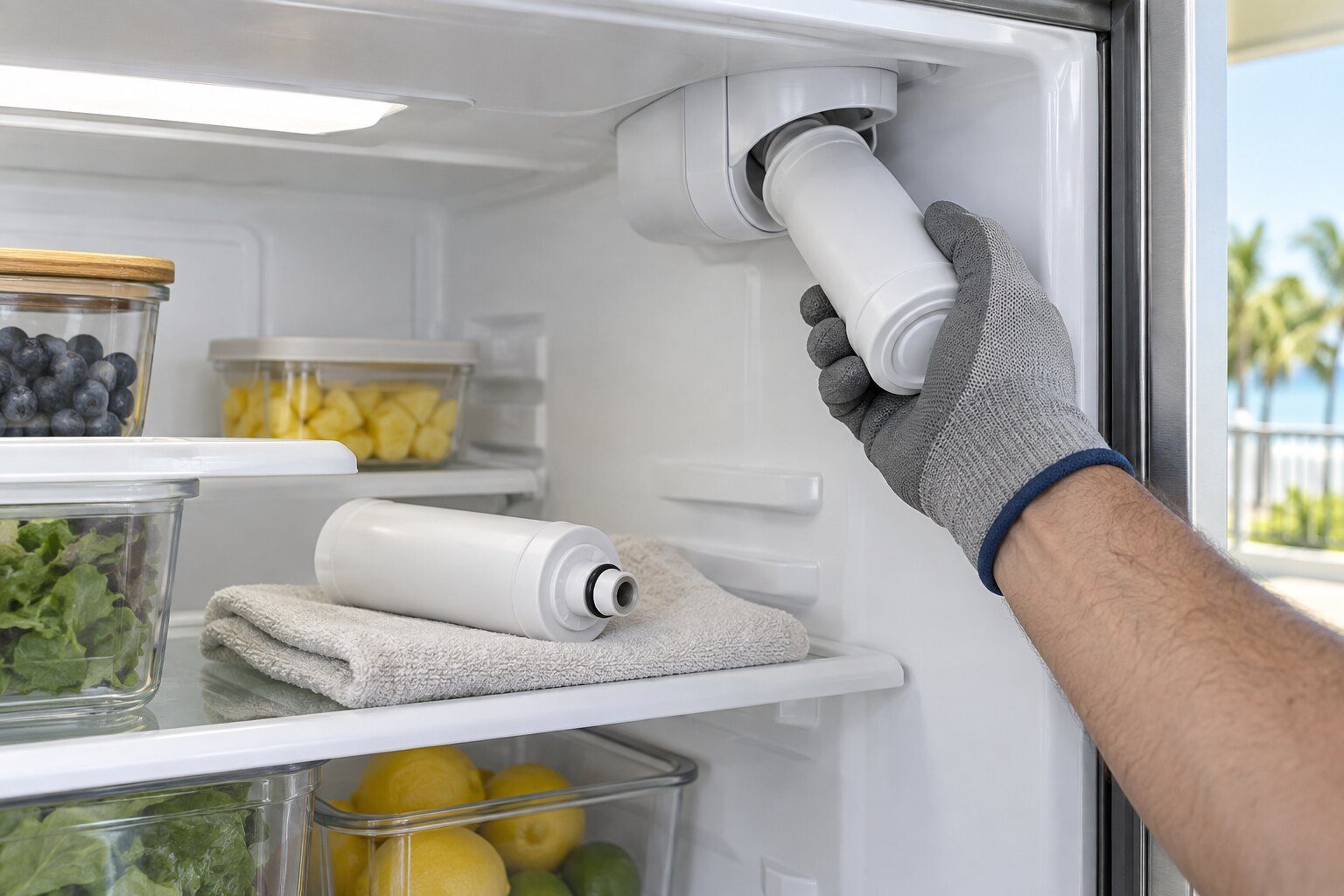
Six months or around two hundred gallons is the manufacturer's guidance, and it is a reasonable default. What moves it is the water and the household: a family of five drawing water and ice all day reaches two hundred gallons well before six months, while a couple in a second home may not reach it in a year — and a filter left in for a year is worth changing regardless, because what has been caught in it has been sitting in warm water since. The part most people are not told about is the aftermath. A new cartridge introduces air into the line, so the dispenser will spit and the first ice will be cloudy and small, and the fix is to run two to three gallons through the dispenser before judging anything. Discard the first two batches of ice. If the dispenser is still slow after that, the usual cause is a cartridge not fully seated rather than a defective one.
The full guide
How often should I change my Frigidaire refrigerator water filter has a label answer and a real one, and they are not far apart — but the more useful half of this page is what happens in the ten minutes after the new one goes in.
How often should I change my Frigidaire refrigerator water filter? Six months, with two adjustments
Six months or about two hundred gallons is the manufacturer's guidance and it is sensible as a default.
The two adjustments are both about usage.
A busy household reaches the gallons first. Five people drawing water, filling bottles and making ice all day will pass two hundred gallons in three or four months. The date is not the constraint; the volume is.
A light household reaches neither. A couple, or a second home used a few weeks a year, may not reach two hundred gallons in eighteen months. Change it at a year anyway — everything the cartridge has caught has been sitting in warm, still water since it caught it, and that is a different problem from an exhausted filter.
The indicator light is a timer
Worth knowing so it is not over-trusted. The filter light on the panel is a countdown — days, or gallons dispensed, depending on the model. It has no idea what your water is like and no way to measure the cartridge.
Use it as a reminder. Do not use it as permission to leave a filter in for eighteen months because the light has stayed dark.
The part nobody warns you about
A new cartridge is dry, and fitting it puts air into the water line. For the first few minutes afterwards:
The dispenser spits and sputters. That is air. It is loud and it is alarming and it is normal.
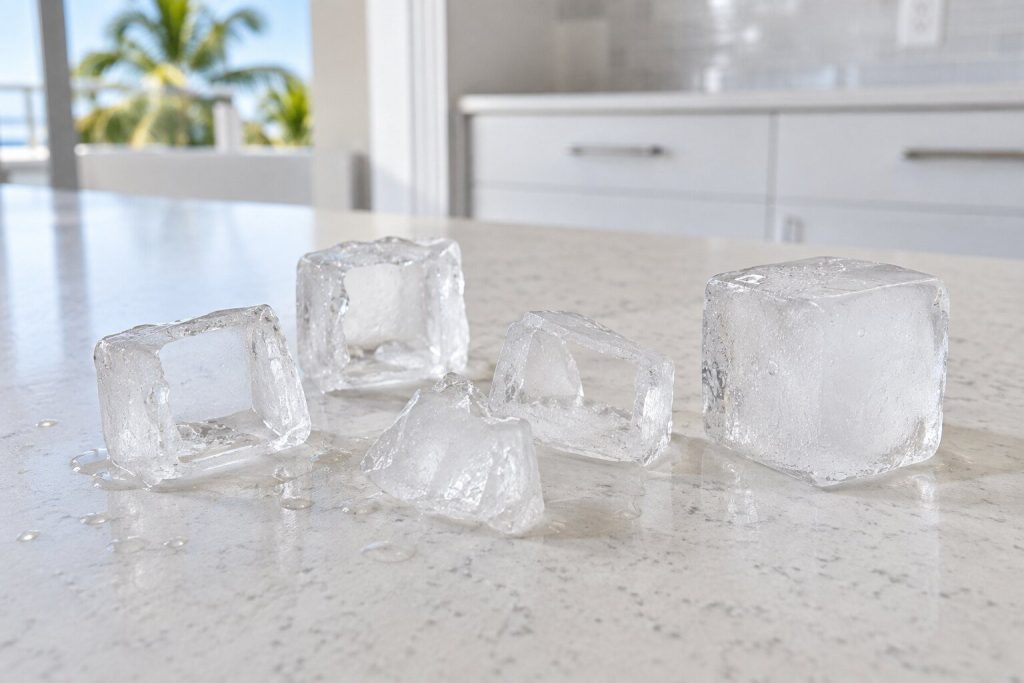
The first ice is cloudy, small and misshapen. Also air, plus the residue of the manufacturing process in the new cartridge.
The water tastes odd. Carbon fines from a new filter.
All three clear if you flush two to three gallons through the dispenser, in stages, with a jug — and discard the first two batches of ice. People who do not do this conclude the new filter is defective and take it back, which is a wasted trip on a perfectly good cartridge.
The failure that is not the filter
By far the most common water problem we are called about on these cabinets is a dispenser that has become slow, and by far the most common cause is a cartridge that is not fully seated.
It does not leak. That is what makes it hard to spot. A filter sitting a fraction short of home simply restricts the flow, so the dispenser slows over weeks until somebody calls it broken.
Fitting one properly means turning it to a firm stop, not to the point where it stays in place. If yours has been changed several times by different people, take it out and refit it deliberately before assuming anything is wrong.
Genuine versus generic
You do not have to use the maker's own cartridge, and the reason to think about it is not the filtering.
It is the seat. Generic cartridges vary slightly at the shoulder, and a filter head that has been opened and closed on three different brands over four years stops gripping any of them reliably. That failure shows up as a slow dispenser, occasionally as a drip, and it is a filter head replacement rather than a cartridge.
If you use generics, staying with one brand is worth more than the brand you pick.
When there is no water at all
Different problem, and the filter is rarely the answer. Nothing at all from the dispenser points at the supply:
A shut-off valve at the wall nobody opened fully. A quarter-inch line kinked behind the cabinet when it was pushed back — the single most common one we find. Or, on a house with a cold night behind it, a frozen line in the door.
There is also a bypass plug on most of these, which goes in where the filter would be. If somebody has left the bypass in place instead of a cartridge, the water works and is unfiltered, which is worth checking on a machine that arrived with the apartment.
If it turns out to be a repair
What this leads to, and what it costs
Every job on this site is priced the same way: an on-site diagnostic first, the figure agreed in writing before anybody starts.
-
from $105 Water dispenser and filter service
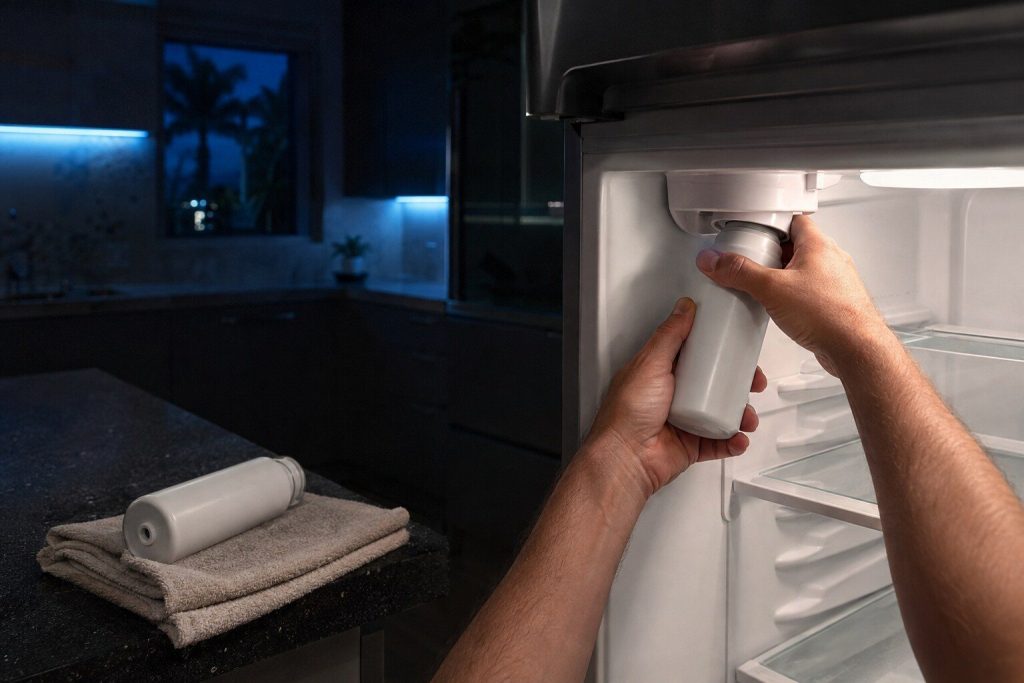
Slow water, no water, a filter that will not seat or a dispenser that has started to taste of something. The circuit is short — supply, shut-off, filter, valve, tank, line, dispenser — and the answer is usually in the first half of it. On a French door or side-by-side cabinet this is also the circuit behind most 'no ice' calls, so the two get looked at together.
- One short circuit behind both the water and most of the ice complaints
- A filter past its date changes flow, taste and cube size at once
- A frozen tank in the fresh-food compartment is a temperature problem, not a plumbing one
-
The cubes are arriving but they are not right Small, hollow or cloudy ice
This is a flow complaint rather than a freezing one, and it is almost always upstream of the ice maker. The mold fills for a fixed time, so if less water arrives in that time you get a smaller cube, a hollow one, or a shell that collapses in the glass. The filter is the first suspect, the supply is the second, and the third is a freezer that is not quite cold enough.
- The mold fills for a fixed time — less water in means a smaller cube out
- A filter past its date changes cube size before it changes anything else
- Cloudy ice is usually air and minerals in the water, not a failure at all
Questions people ask about this
How often should I change my Frigidaire refrigerator water filter if the light has not come on?
The indicator is a timer or a gallon counter, not a measurement of the filter. It is a useful reminder and it knows nothing about your water, so treat it as a prompt rather than an instruction — and change the filter at a year even if the light has stayed dark.
Do I have to use the manufacturer's own cartridge?
You do not have to, and the risk is the seat rather than the filtering. Generic cartridges vary slightly at the shoulder, and a filter head that has been opened and closed on three different brands eventually stops gripping any of them properly — which shows up as a slow dispenser rather than as a leak.
Maintenance & Prevention
More guides like this one
-
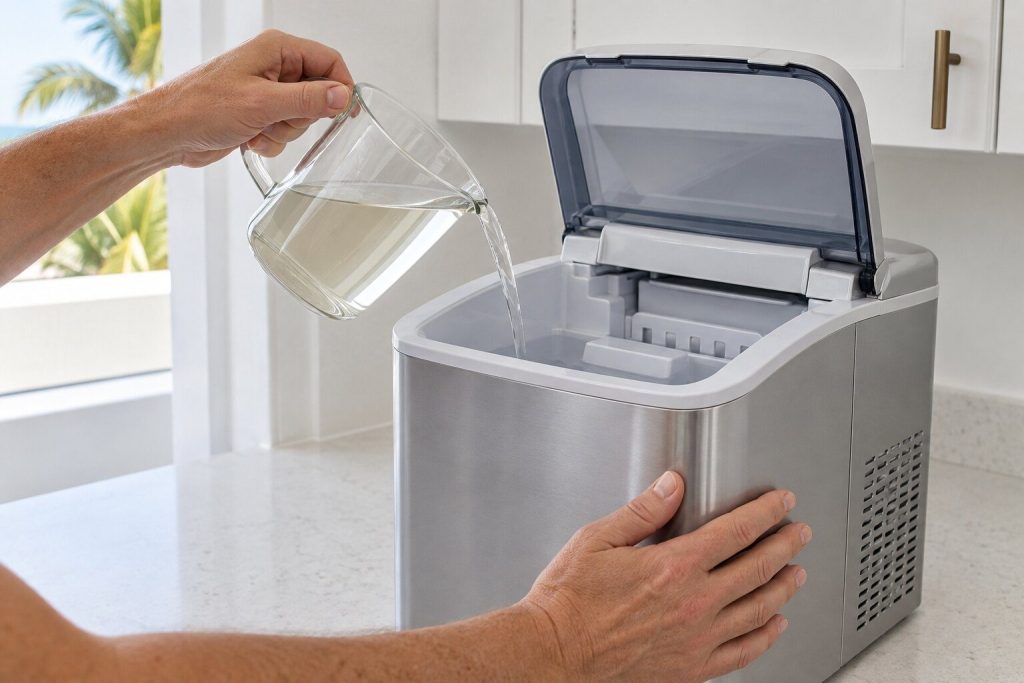
Descaling a Frigidaire Countertop Ice Maker With Vinegar
South Florida water scales the evaporator fingers, and scale is an insulator. A machine gone slow and cloudy usually needs descaling, not repair.
Read more -
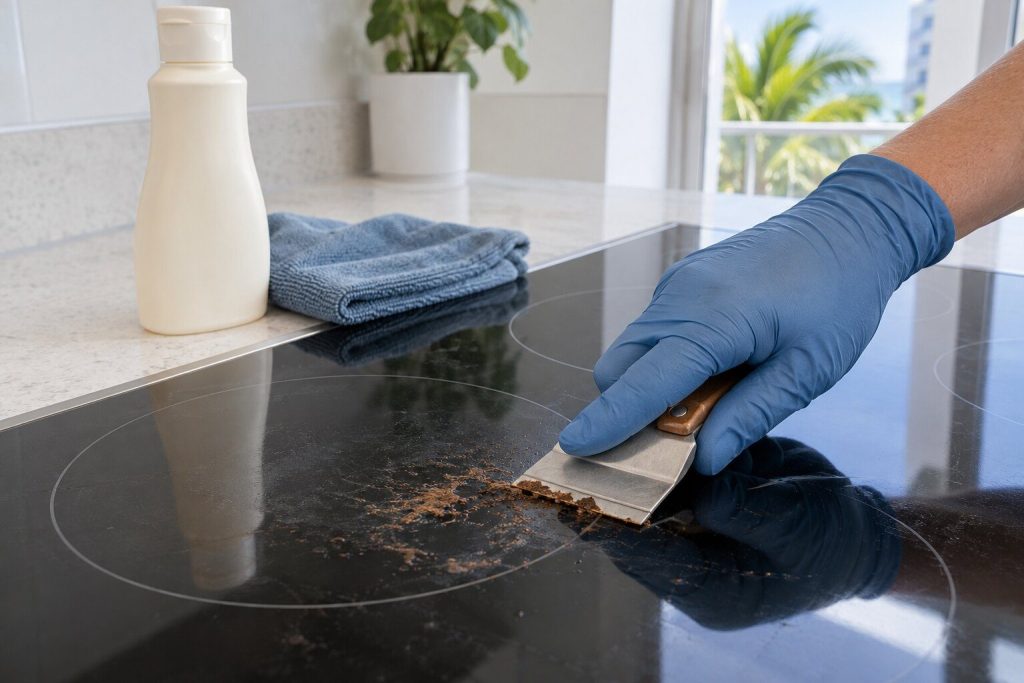
Cleaning a Ceramic Cooktop Without Scratching It
Three things mark these permanently, and one tool everybody is afraid of is the right one. A marked top is not repairable, so the method matters.
Read more -
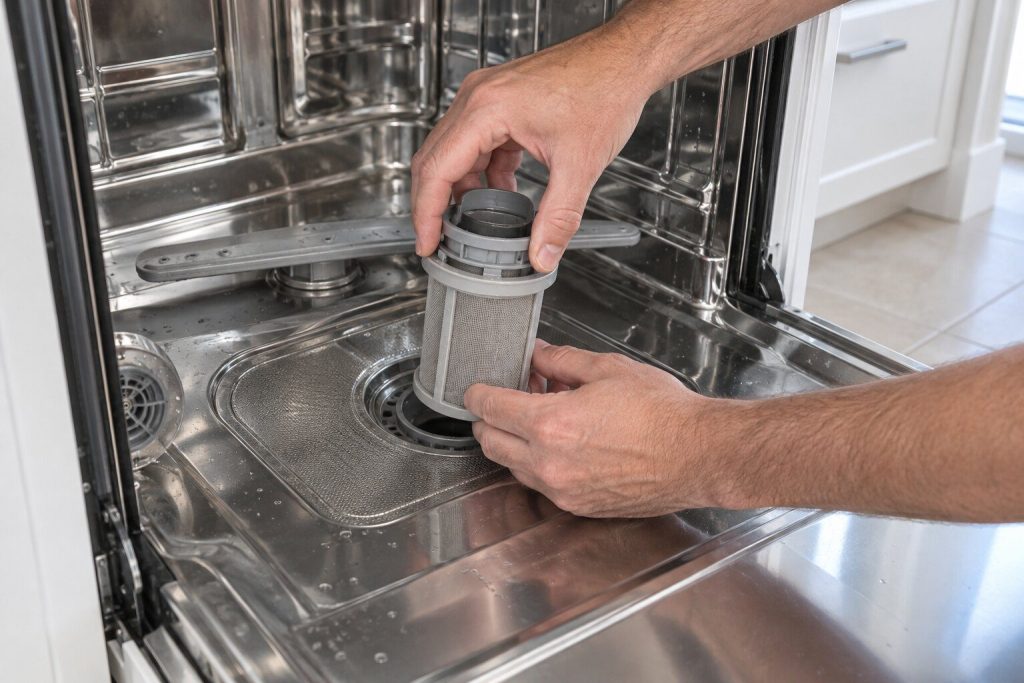
The Frigidaire Dishwasher Filter, and the Five Minutes That Prevent a Drain Call
It twists out by hand, it is an owner item like a lint screen, and the maker's own answer to the i40 code is to clean it.
Read more
Tell us the model number and what it is doing.
This article is based on:
- Official manufacturer documentation
- Internal repair procedures
- Technician repair history
- Company quality standards