FrigidaireRepair Miami

26 behaviors · 11 appliances

Start from what it is doing, not from what it is called.

Each page carries the free checks worth doing first, what it usually turns out to be, and how the answer changes with the age of the machine.

  • 26 behaviors written up
  • 5 appliances that display no code at all
  • 23 codes, where the maker documents one
  • 0 invented to fill a gap

Start from what you can see

Twenty-six behaviors, in plain words

Each page carries the free checks worth doing first, what it usually turns out to be, and how the answer changes depending on the machine you have.

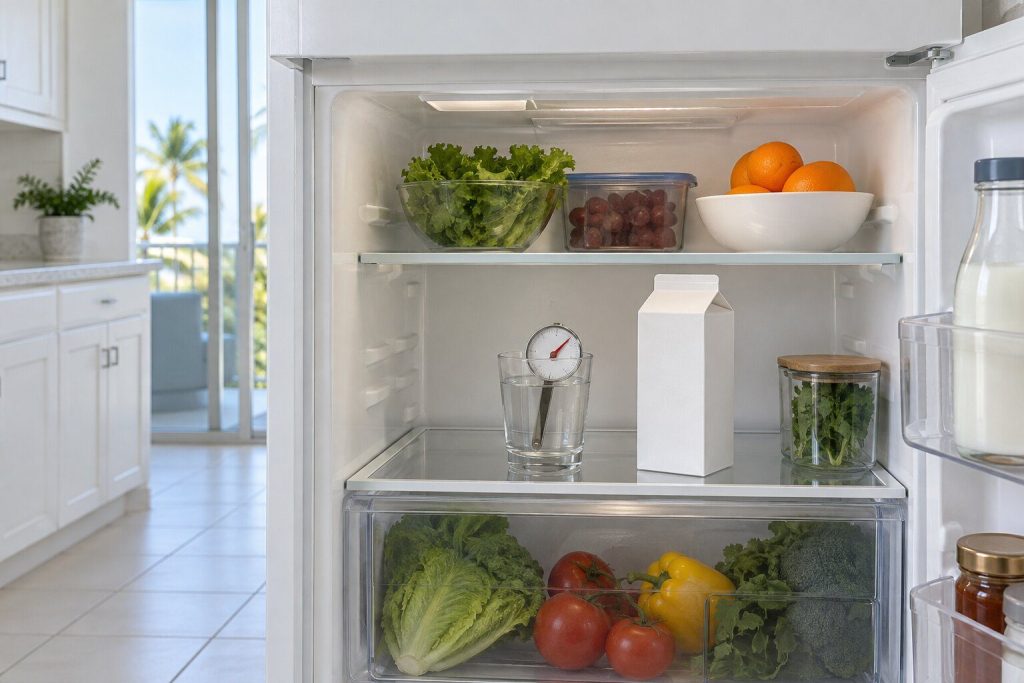
  • The open fresh-food compartment of a white top-freezer refrigerator with an ordinary dial thermometer standing in a glass of water on the middle shelf reading well above forty, a carton of milk beside it.
    It runs, the light comes on, and the food is warm

    Refrigerator not cooling

    The cabinet is doing something — you can hear it — and it is still not cold. On most of the machines this badge sells there is nothing on the front to read, so the first useful thing you can do is not a repair at all: put a thermometer in each compartment and note the two numbers an hour apart. That pair tells us more than any description of the noise, and it is the difference between an hour of guessing and a visit that arrives with the right parts.

    • A cold freezer with a warm fridge is an air problem, not a refrigerant one
    • Both halves drifting together is the dearer diagnosis, and worth knowing before we arrive
    • Three free things — a blocked vent, a stuffed condenser, a door held ajar — end a real share of these
    What it usually means
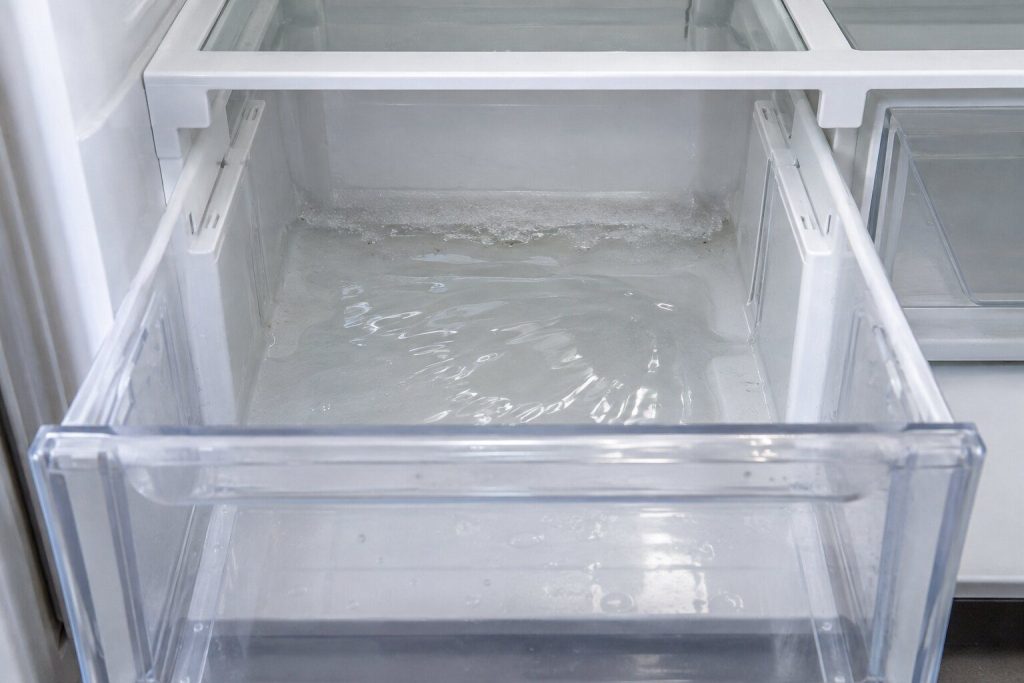
  • A clear crisper drawer pulled forward in a bright refrigerator interior with a shallow pool of water standing in the well underneath it and a thin sheet of ice at the back edge.
    A puddle on the floor, or water under the crisper drawers

    Water under the refrigerator

    The commonest refrigerator call we take in South Florida, and usually the cheapest to put right. Where the water shows up is the whole diagnosis: under the drawers points at the defrost drain, on the floor at the front points at the drain pan or the door, and water at the back points at the supply line. Before you mop it, look and remember which of those three it was.

    • Under the crisper is the defrost drain, and that is the usual answer here
    • At the back is a water supply problem, which is the one that damages floors
    • A cabinet that has been leaking for weeks is a cabinet-and-floor question too
    What it usually means
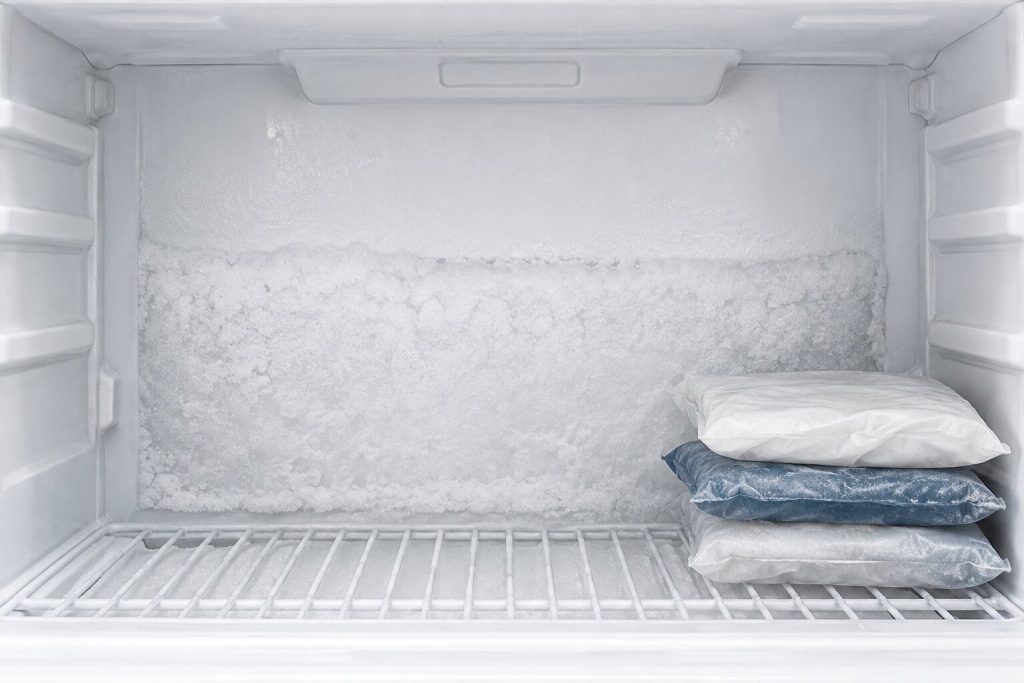
  • The inside of a freezer compartment with the food removed, the white rear panel carrying a thick even crust of frost that has climbed from the bottom to halfway up, and frozen packets stacked to one side.
    Ice on the back wall, or a freezer that keeps growing a crust

    Frost building up inside

    A frost-free cabinet is not supposed to accumulate anything, so frost is always a message. Where it is tells us which message: a sheet on the freezer back wall is the defrost circuit, frost around the door is a seal, and a fine crust over everything after a hot week is usually the humidity that came in through a door that was left ajar.

    • A sheet of ice on the back wall is the defrost circuit, and it will not clear itself
    • Frost at the door edge is a seal or an alignment question
    • Chipping it out buys a week; the reason it formed decides whether it comes back
    What it usually means
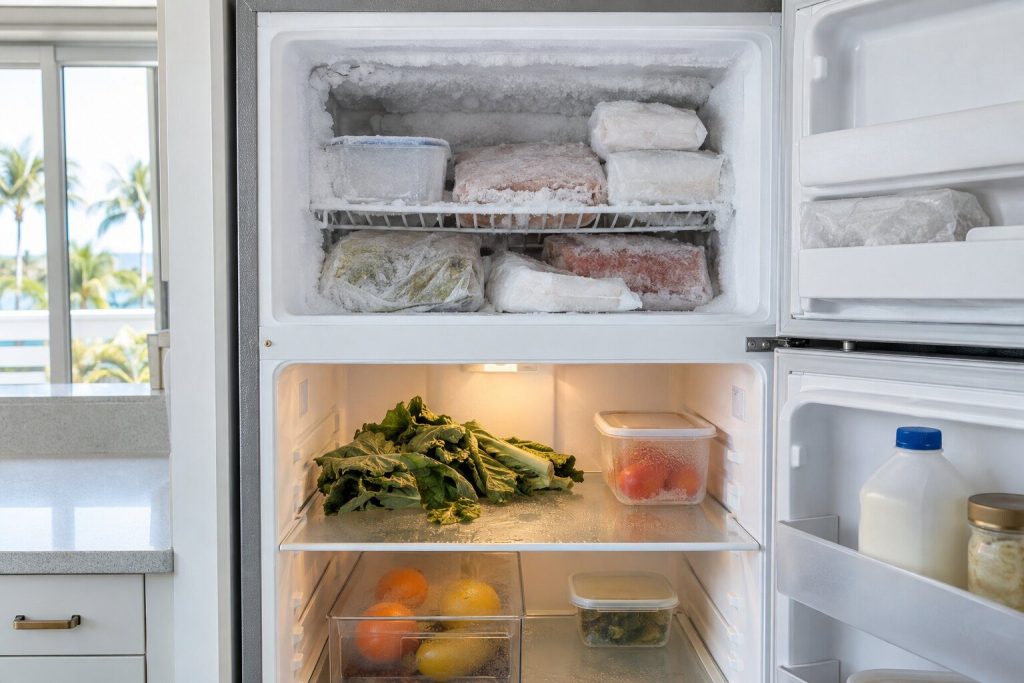
  • A split view of an open top-freezer refrigerator: the upper freezer basket packed with properly frozen food and heavy frost, and the fresh-food shelf below holding wilted greens and condensation on the shelf glass.
    One half of the cabinet is fine and the other is not

    Fridge warm, freezer cold

    This is the single most useful thing an owner can tell us about a refrigerator, because it rules out most of the expensive answers immediately. Almost every cabinet this badge sells makes its cold in one place and moves air to the other, so a cold freezer proves the sealed system is working and points the whole diagnosis at air: a fan, a damper, a duct or a coil under ice.

    • A cold freezer proves the compressor and the refrigerant are doing their job
    • The problem is air: fan, damper, duct or a coil under frost
    • This is usually the cheaper half of the refrigeration repair list
    What it usually means
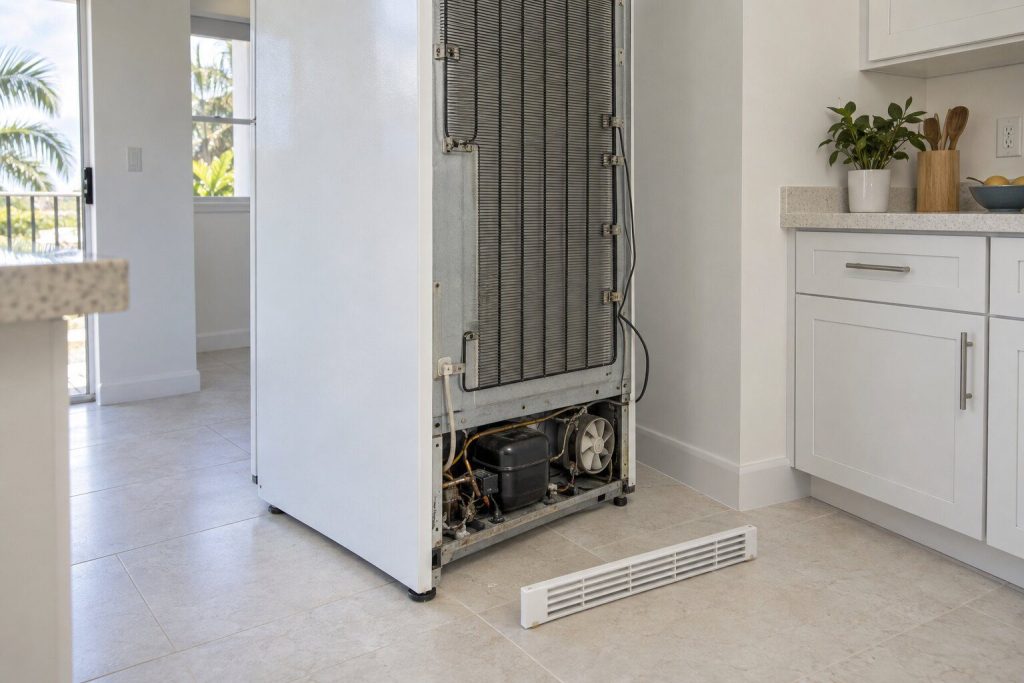
  • A white refrigerator pulled a foot out from a light kitchen wall at night-free daylight, the base grille off and the compressor and fan visible low at the back, a pale tile floor.
    Chirping, rattling, buzzing or a bang from the back

    Refrigerator making a noise

    Refrigerators are among the few appliances that give warning before they fail, and the noise is usually it. What matters is which noise: a chirp or squeal that comes and goes with the door is the evaporator fan, a rattle from the floor at the back is the condenser fan or the drain pan, and a click every few minutes with no cooling is the compressor relay. None of them are ignorable, and one of them is cheap this week and dear next month.

    • A chirp that changes with the door is the freezer fan — cheap now, warm food later
    • A rattle at floor level is usually the condenser fan or a loose drain pan
    • Clicking with no cooling is the compressor relay and is worth attending to quickly
    What it usually means
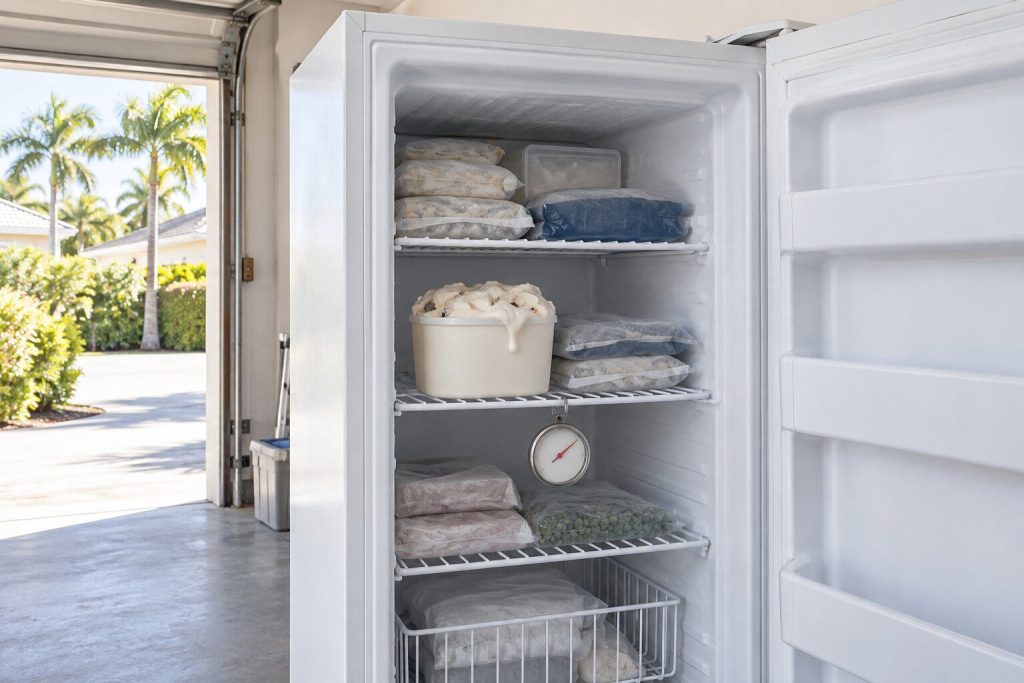
  • An open upright freezer in a bright garage with a tub of ice cream on the middle shelf visibly soft at the edges, a dial thermometer hanging from the wire shelf reading above zero, and packets of food beyond.
    The cabinet is running and the food has gone soft

    Freezer not freezing

    The expensive failure, because nothing announces it. A freezer that has drifted from 0°F to 20°F looks and sounds exactly like one that is working, and the first sign is usually the food. In South Florida there is an extra suspect that is not the machine's doing at all: a cabinet in a garage is being asked to work at an ambient it was never rated for.

    • Nothing tells you until the food does — a thermometer is the whole early warning system
    • A garage in August is not the room the cabinet was designed for
    • Upright and chest freezers fail in different places, so say which you have
    What it usually means
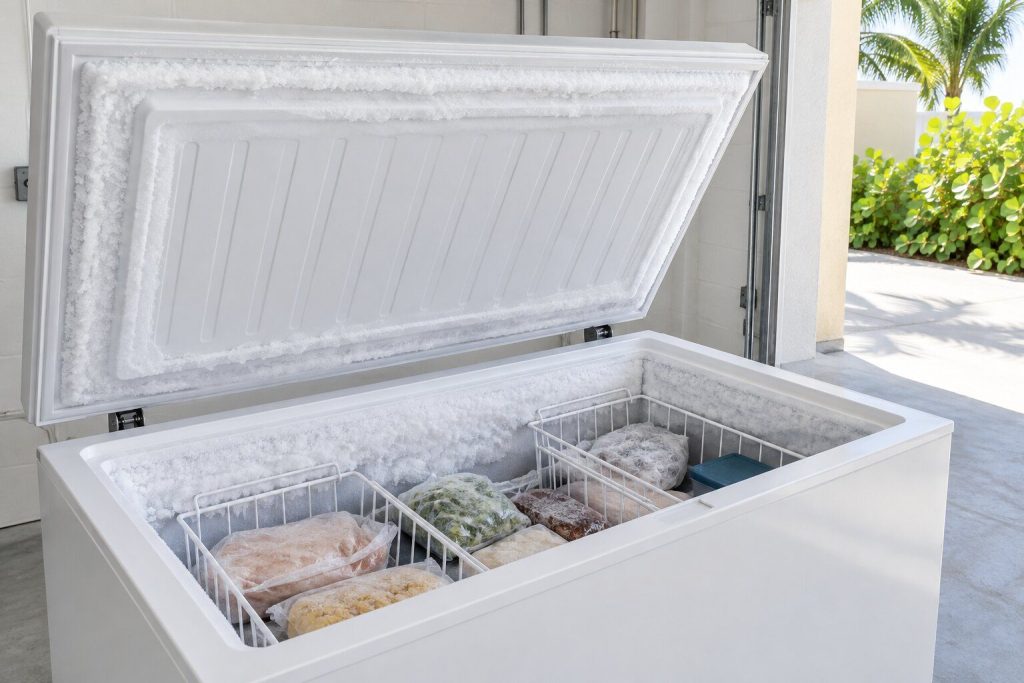
  • A white chest freezer with its lid up in a bright garage, thick frost built up along the lid seal and down the inside of the near wall, baskets of frozen food below.
    A crust on everything, or ice growing on the walls

    Frost building in the freezer

    On a frost-free upright this is a message and on a manual-defrost chest freezer it is housekeeping — so the first question is which cabinet you have. An upright that grows frost has a defrost circuit that has stopped; a chest freezer that grows frost has been opened, or has a lid that is not sealing, and is doing what it was designed to do.

    • Frost-free upright: frost is a failure. Chest freezer: frost is maintenance
    • Ice at the lid line points at the seal or the hinge
    • Chipping it out is safe with plastic, never with metal
    What it usually means
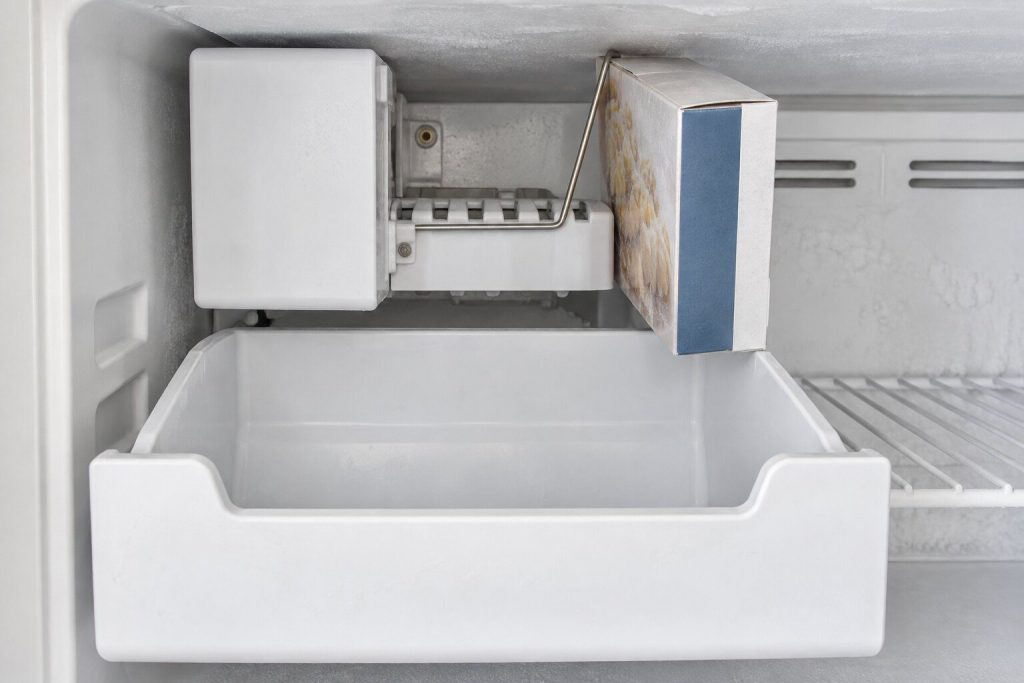
  • The inside of a freezer compartment with the ice bin pulled out and completely empty, the white ice maker module above it with its wire shut-off arm raised in the up position and a box of frozen food pressed against it.
    The bin is empty and nothing is arriving

    Ice maker not making ice

    One question sorts most of these before anybody is booked: does the water dispenser still work? Water at the dispenser but no ice separates the ice half of the circuit from the supply in a sentence, and neither water nor ice sends the whole diagnosis back to the filter and the shut-off. Half of these calls end on the water side rather than at the ice maker itself.

    • Water at the dispenser but no ice narrows this to the ice half of the circuit
    • No water either sends us to the filter, the line and the shut-off
    • The fill tube freezing closed is commoner than the module failing
    What it usually means
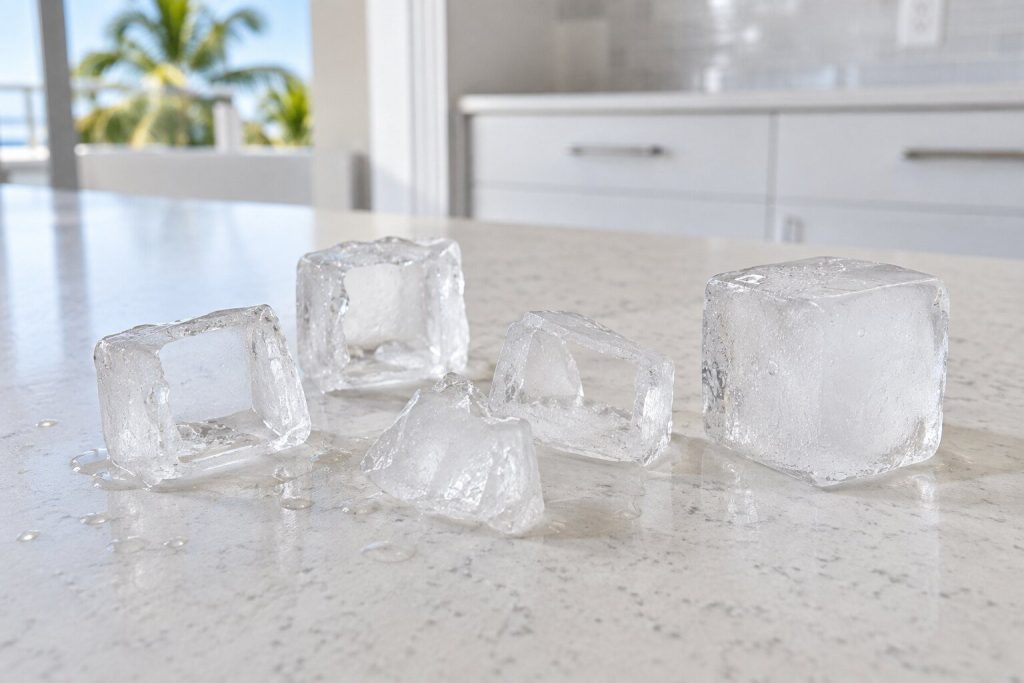
  • A handful of ice cubes on a light counter, several of them hollow shells with the centers open and others only half the size of the rest, beside a full-size cube for comparison.
    The cubes are arriving but they are not right

    Small, hollow or cloudy ice

    This is a flow complaint rather than a freezing one, and it is almost always upstream of the ice maker. The mold fills for a fixed time, so if less water arrives in that time you get a smaller cube, a hollow one, or a shell that collapses in the glass. The filter is the first suspect, the supply is the second, and the third is a freezer that is not quite cold enough.

    • The mold fills for a fixed time — less water in means a smaller cube out
    • A filter past its date changes cube size before it changes anything else
    • Cloudy ice is usually air and minerals in the water, not a failure at all
    What it usually means
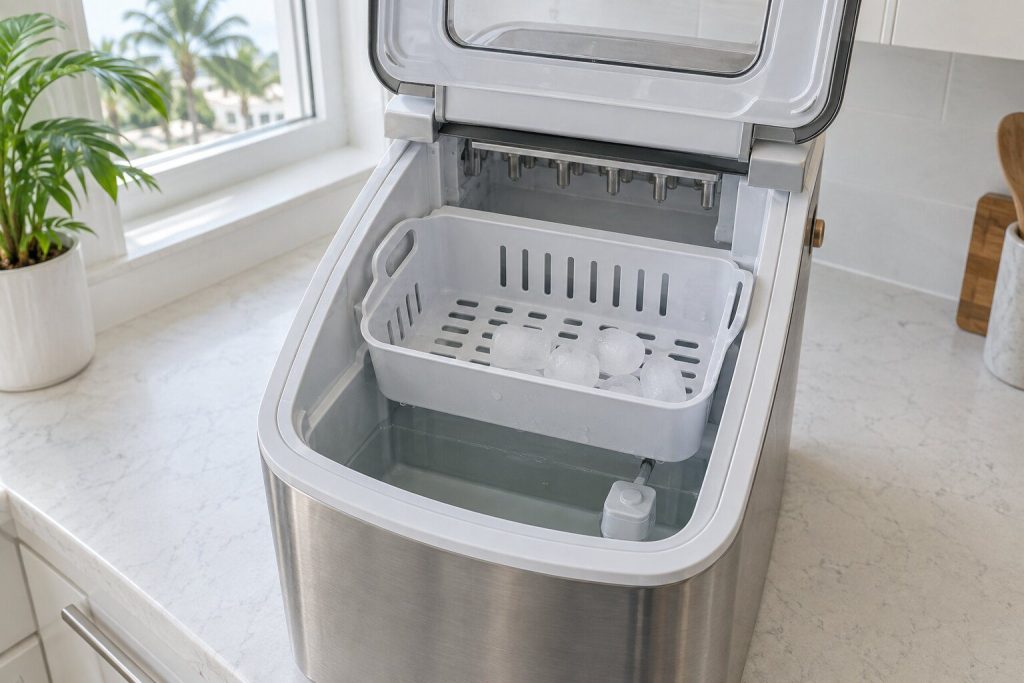
  • The open lid of a small countertop ice machine on a light counter showing a nearly empty basket holding a few cloudy, soft-edged bullet cubes and a shallow reservoir of water below.
    It runs, and the basket stays empty

    Countertop ice maker making little or no ice

    Frigidaire's standalone ice makers are countertop machines you fill by hand, and the failures are small-appliance failures: scale in the water path, a pump that has lost its prime, or the sensor that decides the basket is full being fooled by splash. Before anything else, know one design fact — the basket is not refrigerated, so ice melting back into the reservoir is normal and not a failure.

    • The basket is not refrigerated: melting back into the tank is by design
    • Scale is the ordinary enemy of these machines in this water
    • A full-basket sensor fooled by splash stops a perfectly good machine
    What it usually means
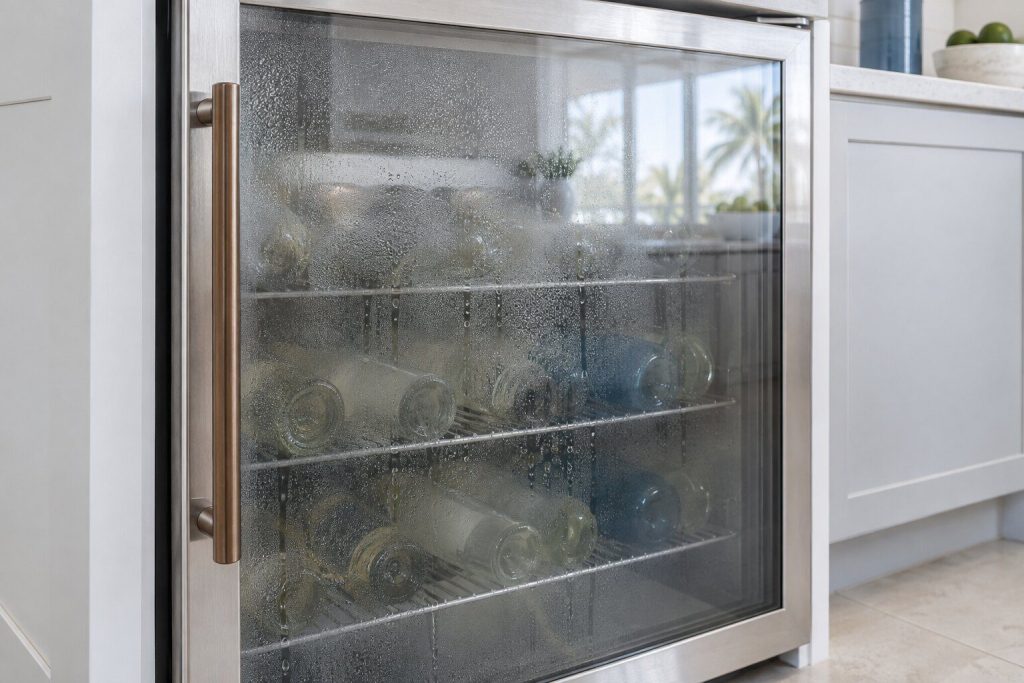
  • The closed glass door of a freestanding beverage cooler fogged with condensation on its inner face, bottles lying on wire shelves dimly visible behind it, a bright kitchen reflected faintly in the pane.
    It is a few degrees warm, usually in the afternoon

    Wine cooler not holding temperature

    Almost every one of these calls is thermal rather than mechanical. These are single-zone cabinets with a glass door and a small compressor, and in a South Florida kitchen at 80°F they are fighting the room all day. Before a part is quoted we want to know two things: what it holds overnight, and whether the cabinet has anywhere to send its heat.

    • Holding overnight but drifting in the afternoon is the room, not the machine
    • A cabinet built flush into a run with no grille is recirculating its own heat
    • Glass doors gain heat, and a full rack can hold one open by a fraction
    What it usually means
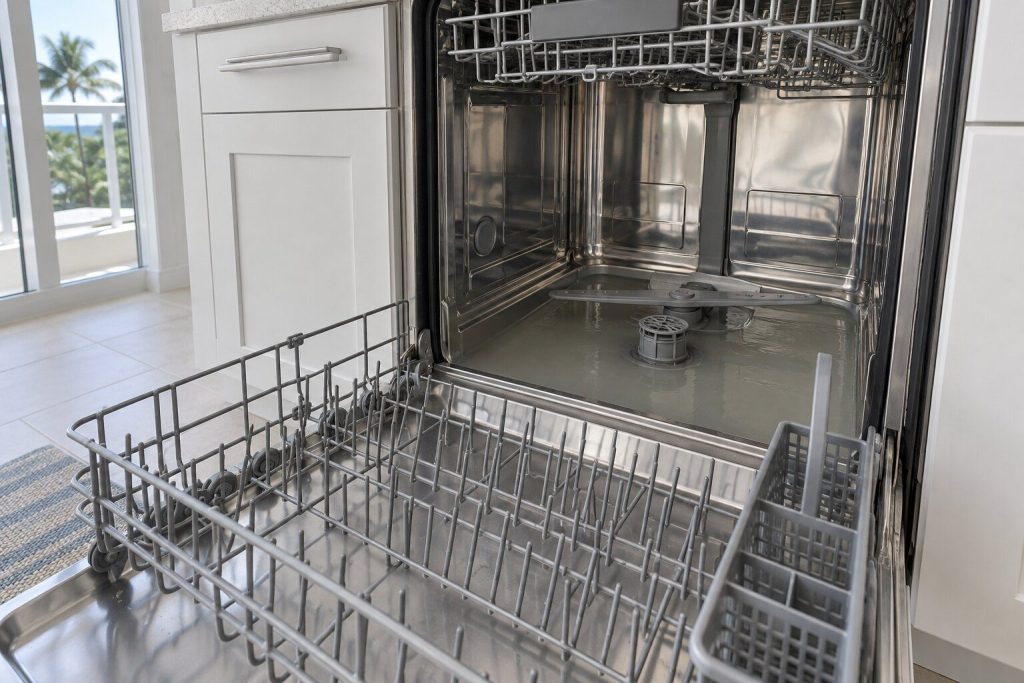
  • The open door of a stainless dishwasher with the lower rack pulled out, an inch of gray standing water covering the floor of the tub around the filter cylinder.
    Water standing in the bottom when the cycle ends

    Dishwasher not draining

    On these machines this is usually something caught rather than something broken, and the filter at the bottom of the tub is the first place to look — it is a two-minute job, most owners have never been shown it, and it ends a large share of these calls. The second place is not in the dishwasher at all: the drain hose, the air gap and the disposal connection under the sink.

    • The filter and the sump first: this is the answer more often than a pump is
    • A new disposal with its knock-out plug still in place blocks every dishwasher fitted to it
    • Slow draining and not draining at all point at different halves of the list
    What it usually means
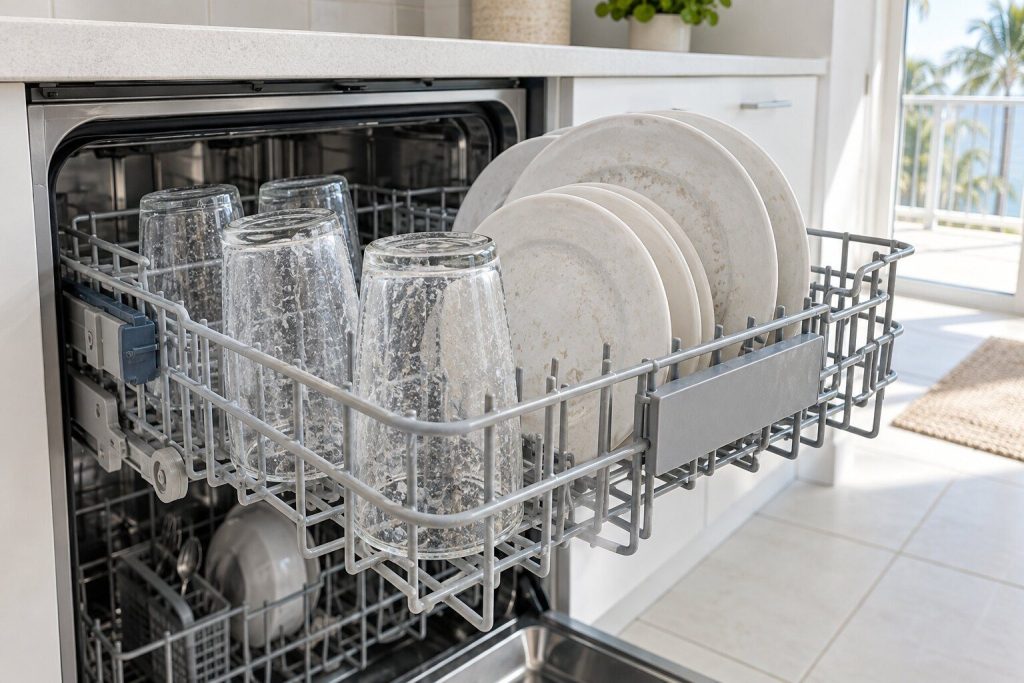
  • Clear drinking glasses and white plates standing in a dishwasher's upper rack with a visible gritty film and dried spots on them, the rack half pulled out into bright kitchen daylight.
    Dishes come out gritty, filmed or still dirty

    Dishwasher not cleaning

    Almost always water not reaching the dishes rather than water that is not hot enough. Spray arms block, filters silt up, and a tall item in the lower rack stops the upper arm turning — and each of those cleans some of the load perfectly, which is why the complaint so often sounds like loading. In this water, scale is the other half of the story.

    • Blocked arms clean part of the load perfectly, which is why it looks like loading
    • A filter unwashed for a year recirculates what it caught
    • Film that wipes off is scale; film that does not is etching, and only one has a repair
    What it usually means
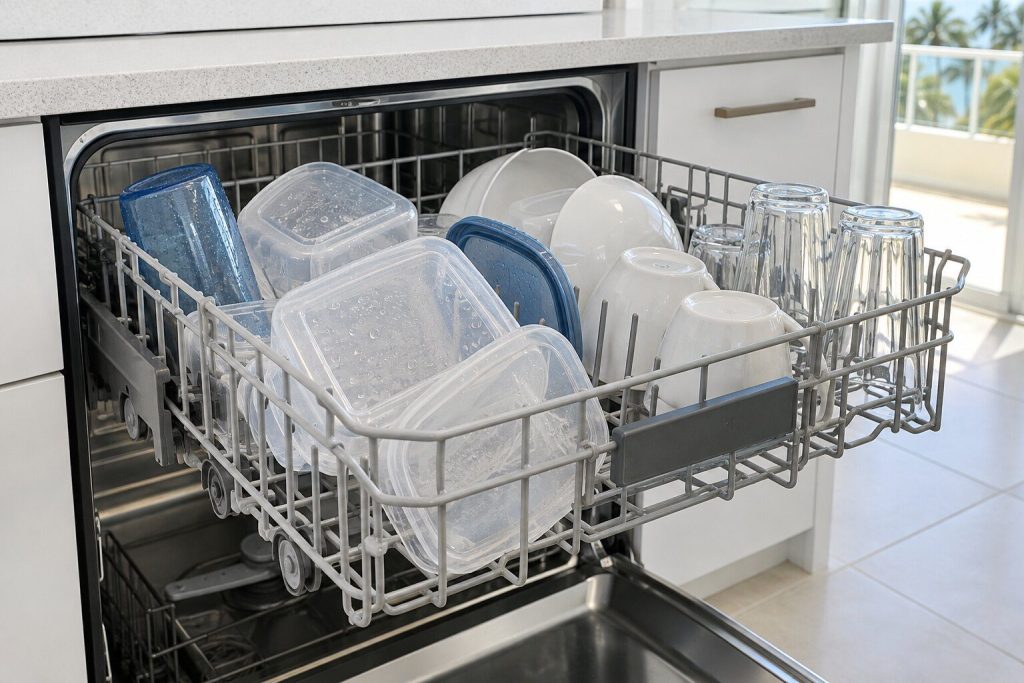
  • A dishwasher's upper rack pulled out at the end of a cycle, plastic food containers and tumblers still beaded with water while the china and glass beside them are dry.
    Everything is wet at the end, plastics worst of all

    Dishwasher not drying

    Worth knowing before you book: Frigidaire's plainer dishwashers dry by holding the heat of the final rinse rather than by blowing air, so plastics coming out damp is close to normal and no repair will change it. Where china and glass are also wet, the heater, the vent flap or the rinse aid dispenser is genuinely at issue.

    • Damp plastic on the plainer machines is the design, not a failure
    • Rinse aid changes drying more than any setting on the panel
    • Wet china as well as wet plastic is the version worth a visit
    What it usually means
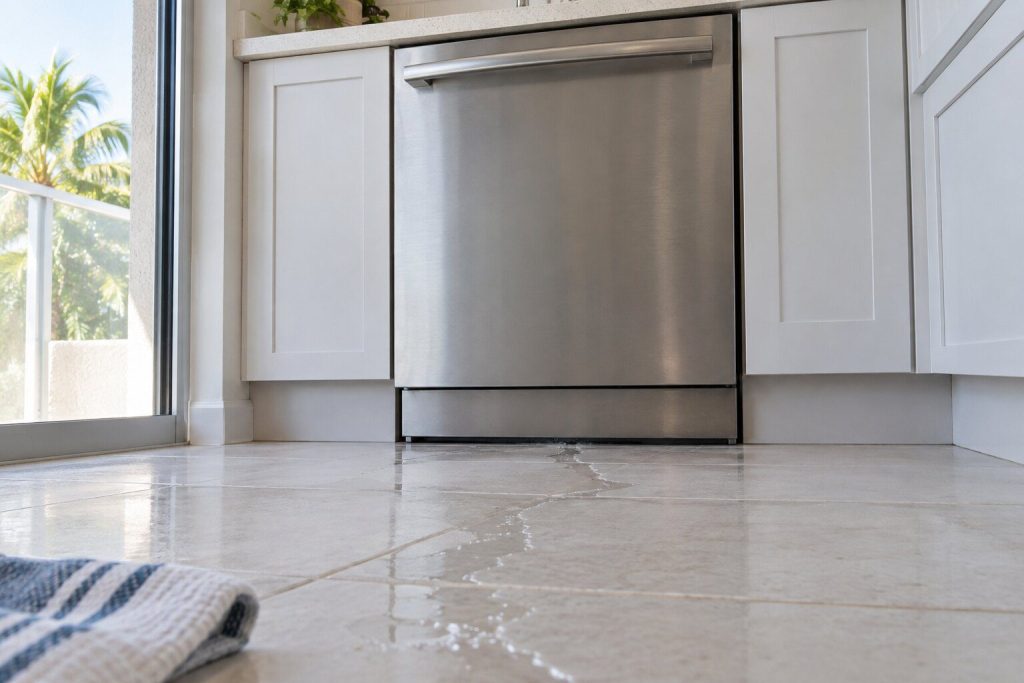
  • A thin spreading line of water on pale tile in front of the closed door of a stainless dishwasher, running out from under the toe panel toward the camera, a folded towel lying ready at the edge of the frame.
    Water on the floor, or a damp cabinet next to the machine

    Dishwasher leaking

    The job here is finding where the water comes from, because the three usual sources need three different repairs. Water at the front is the door seal or the vent, water at the back is the supply or drain connection, and water underneath is the sump or the pump. A dishwasher that has been leaking quietly for weeks is also a cabinet and floor problem, and we would rather say that plainly.

    • Where and when the water appears decides the whole repair
    • A slow leak at the back damages the cabinet long before it reaches the floor
    • A machine racked out of square after new countertops leaks at one corner
    What it usually means
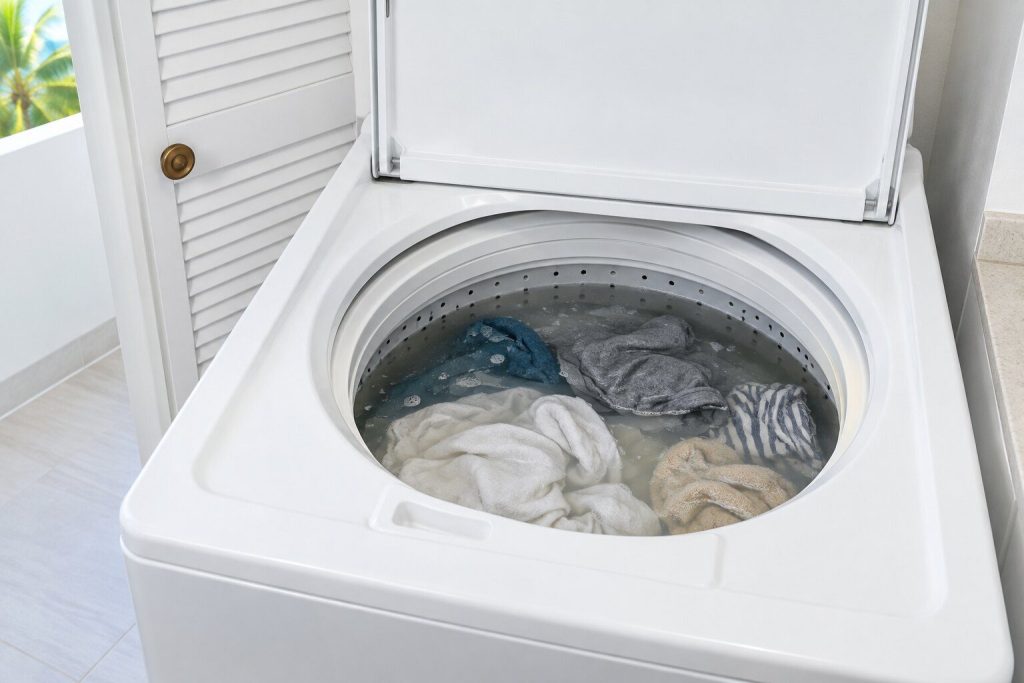
  • The open lid of a white top-load washing machine showing the tub still full of gray water with washing floating in it at the end of a cycle.
    The cycle ended and the drum is still full

    Washer will not drain

    On the older machines that fill South Florida closets this is usually an obstruction rather than a failure, and on a front-loader there is a filter trap behind the lower panel that almost nobody has ever opened. Coins, hairpins, a child's sock: they clear the drum and stop at the pump. The other half of the answer is not in the machine at all — the hose, the standpipe, and in an apartment the stack it shares with the flat above.

    • The filter trap on a front-loader is the first place to look and most owners have never opened it
    • A pump that hums and moves nothing is blocked rather than dead
    • In a condominium a surcharging stack puts the water back and the machine is innocent
    What it usually means
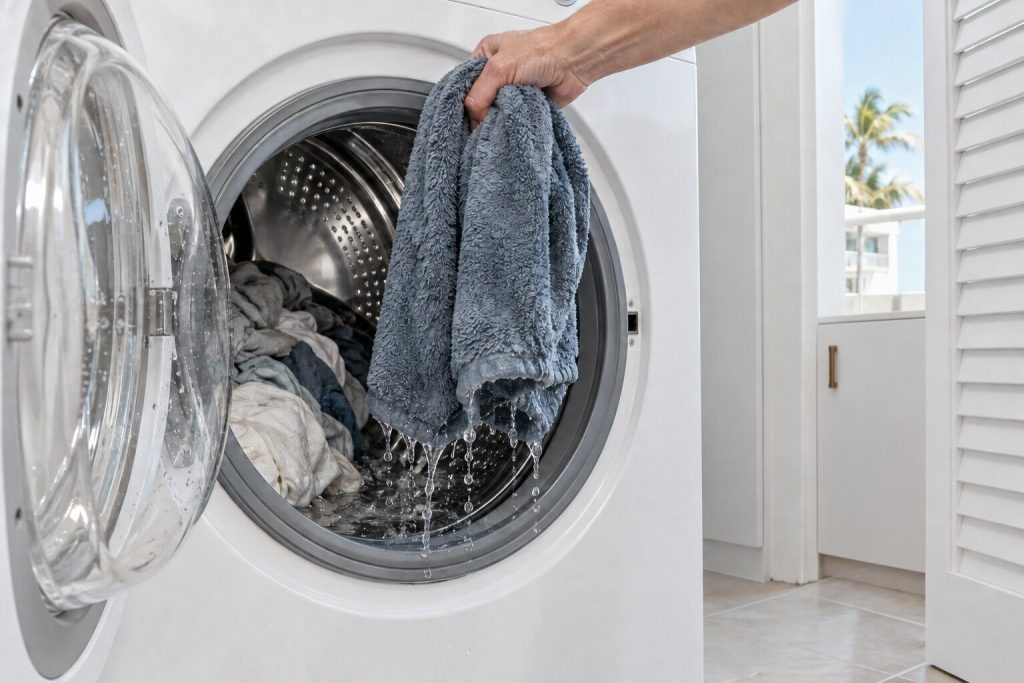
  • A heavy soaking towel being lifted out of a white washing machine drum, water running off it back into the tub, the rest of the load piled to one side of the drum.
    The load comes out soaked, or the spin never starts

    Washer will not spin

    Two quite different machines wear this complaint. On a top-loader it is usually the lid switch or the drive; on a front-loader it is the door lock, the belt or a load the machine has decided it cannot balance. The useful thing you can tell us is whether the drum turns freely by hand and whether the machine tried and gave up or never tried at all.

    • Top-loaders: the lid switch is one of the most common failures on an older machine
    • Front-loaders: the door lock has to report closed before anything spins
    • A machine that tries and aborts is a balance story, not an electrical one
    What it usually means
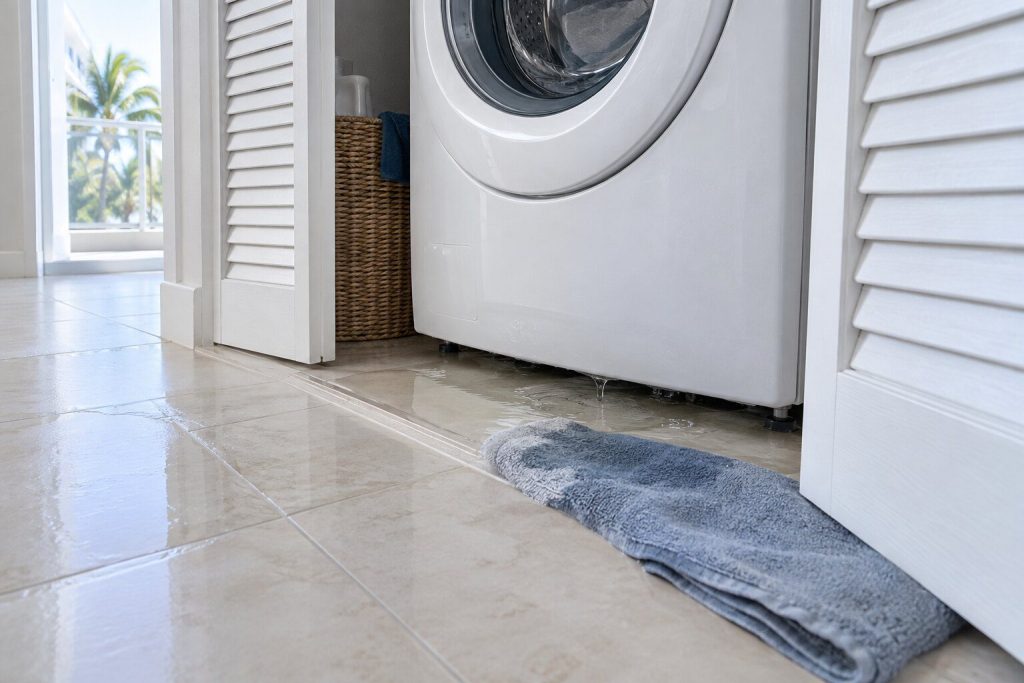
  • Water spreading across pale tile at the threshold of a narrow laundry closet from under a white washing machine, a folded towel already darkened at one edge.
    Water on the laundry room floor

    Washer leaking

    Where the water appears decides the repair, so the first job is watching rather than mopping. Front of a front-loader is the door boot or the glass; behind the machine is a hose or the inlet valve; water that appears only during the drain is the pump, a clamp, or a standpipe that cannot take the flow. And in this climate the door boot is the one we find most.

    • Front, back or only-on-drain — three different repairs
    • A door boot in Miami never dries between washes and eventually perishes at the fold
    • Fill hoses have a service life, and the ones that burst flood a building
    What it usually means
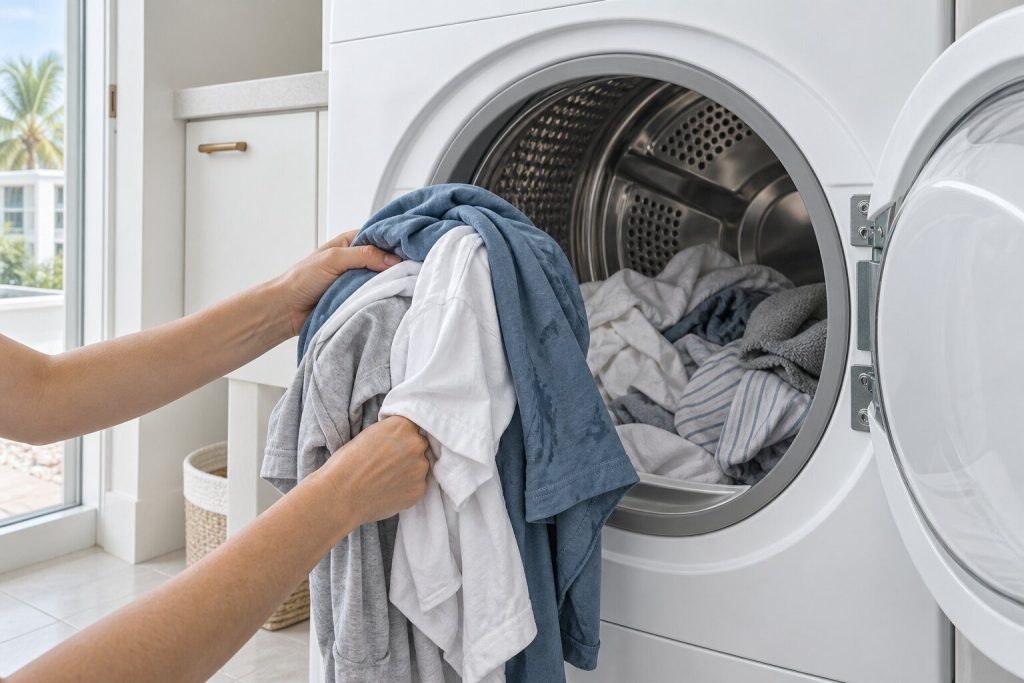
  • A handful of cold damp shirts being lifted from the stainless drum of a white dryer at the end of a cycle, the rest of the load still tumbled inside.
    It tumbles, and the clothes come out cold and damp

    Dryer not heating

    The first thing to establish is whether the machine is failing to make heat or failing to move air, because in South Florida the second is far more common — and no part fitted will fix a duct. Where it is genuinely heat, an electric machine and a gas machine are two different repairs, so knowing which you have shortens the visit.

    • Airflow is the commoner answer here, and it is not a part
    • An electric dryer running on one leg of its supply tumbles cold with a perfect element
    • A thermal cutout that has opened is a symptom: it opened for a reason
    What it usually means
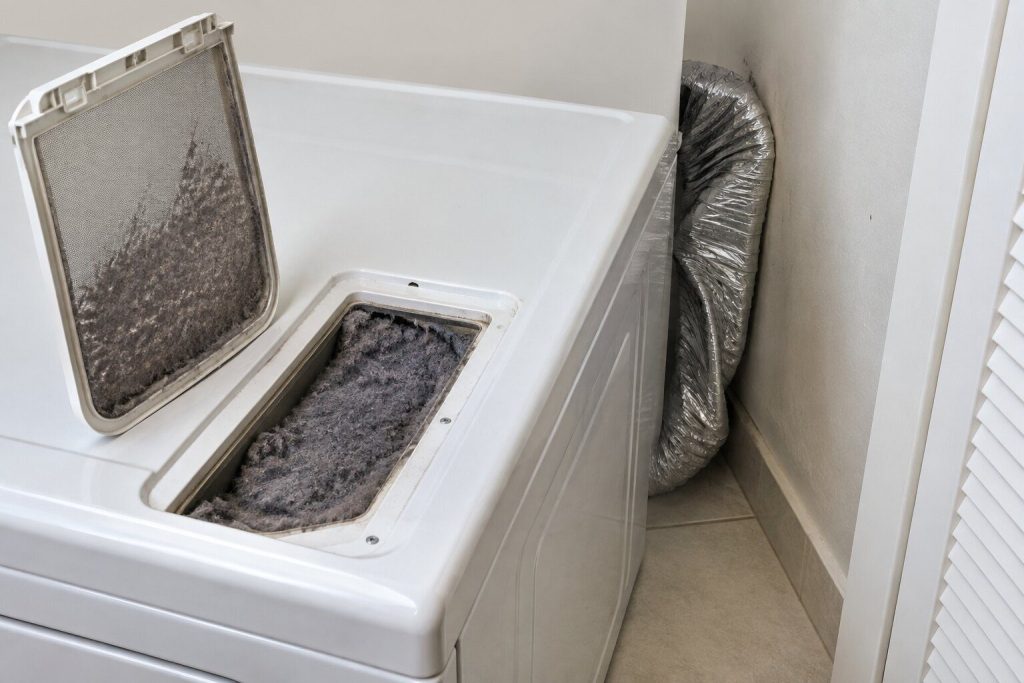
  • A dryer's lint screen lifted clear of its slot and standing to one side, the housing below it visibly packed with gray lint, and a flexible foil duct crushed flat where the machine has been pushed back to the wall.
    Everything dries eventually, but nothing dries in one go

    Dryer takes two or three cycles

    This is the same complaint as no heat, one step earlier, and it has the same answer nine times out of ten: air. A duct with lint in it, a vent flap that no longer opens fully, a screen that is clean but a housing that is not. The genuine machine failures — a moisture sensor coated with softener, a partly failed element — are the rest.

    • Nine out of ten are airflow, and airflow is not a part
    • A moisture sensor coated with fabric softener ends the cycle early, every time
    • Overloading is real: a dryer needs room to tumble
    What it usually means
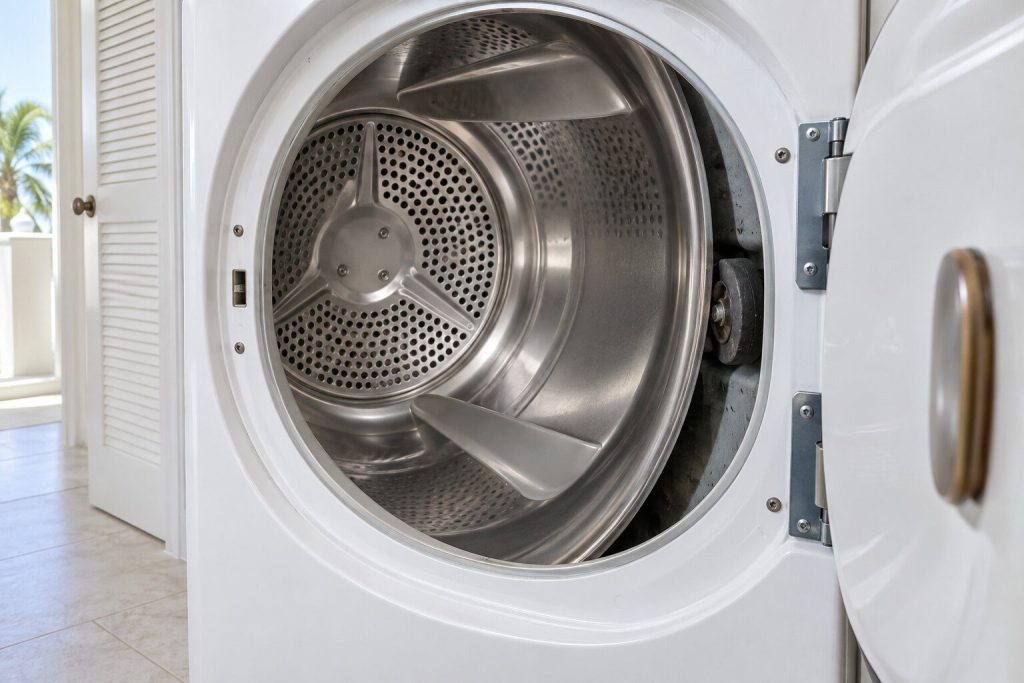
  • The open door of a white vented dryer showing the empty stainless drum and, through the gap at its edge, one of the black support rollers behind it worn flat on one side.
    A noise that started quietly and is getting worse

    Dryer squealing or thumping

    Dryers give more warning than anything else in the house. The squeal of a dry roller or the thump of a worn idler starts weeks before the belt goes, and a machine caught at the noise stage is a straightforward job with common parts. Left until the drum stops turning, it is the same parts plus a wasted trip.

    • The noise is a warning, and acting on it is cheaper than waiting
    • A motor running with a still drum is a broken belt, and forcing it helps nothing
    • Rollers, idler and belt wear together and are replaced together
    What it usually means
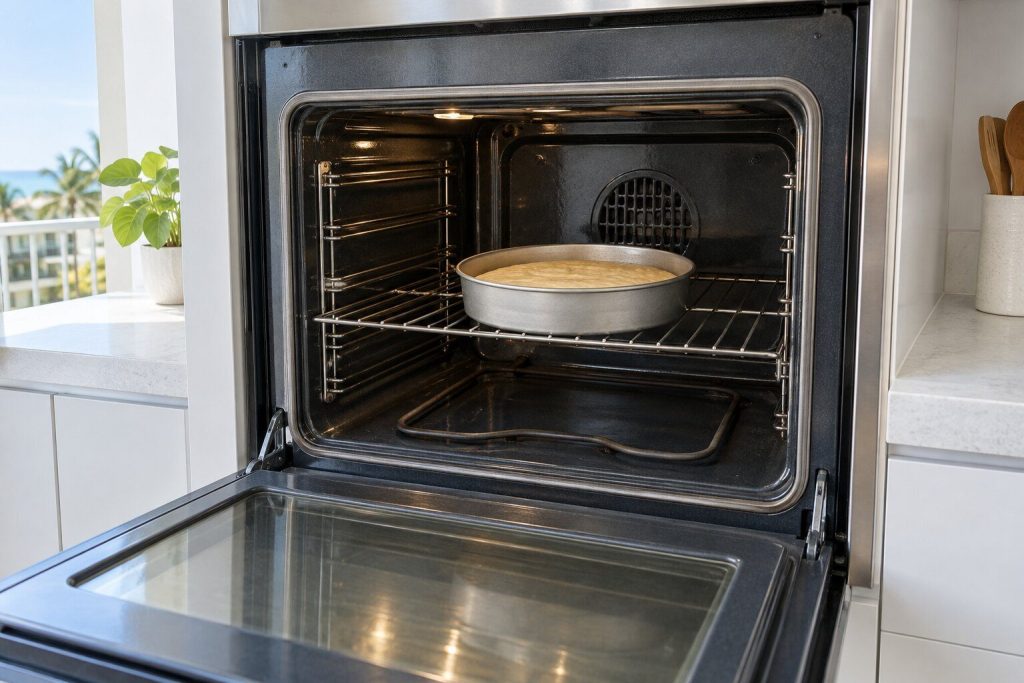
  • A wall oven door open onto a cavity holding a pale, flat, plainly underbaked cake in a tin on the middle rack, the bake element in the floor of the oven dark and cold.
    It stays cold, or never gets near the temperature you set

    Oven not heating

    Two complaints wear one title, and separating them saves a visit. An oven that is stone cold is an element, an igniter or a supply problem; an oven that heats but stops well short is almost always the sensor or the calibration. A thermometer on the middle shelf tells us which one you have, and that decides what rides on the van.

    • Stone cold and never-hot-enough are different repairs
    • On gas, a weak igniter gives slow heat rather than no heat — the classic misdiagnosis
    • An oven thermometer is the cheapest diagnostic tool in the kitchen
    What it usually means
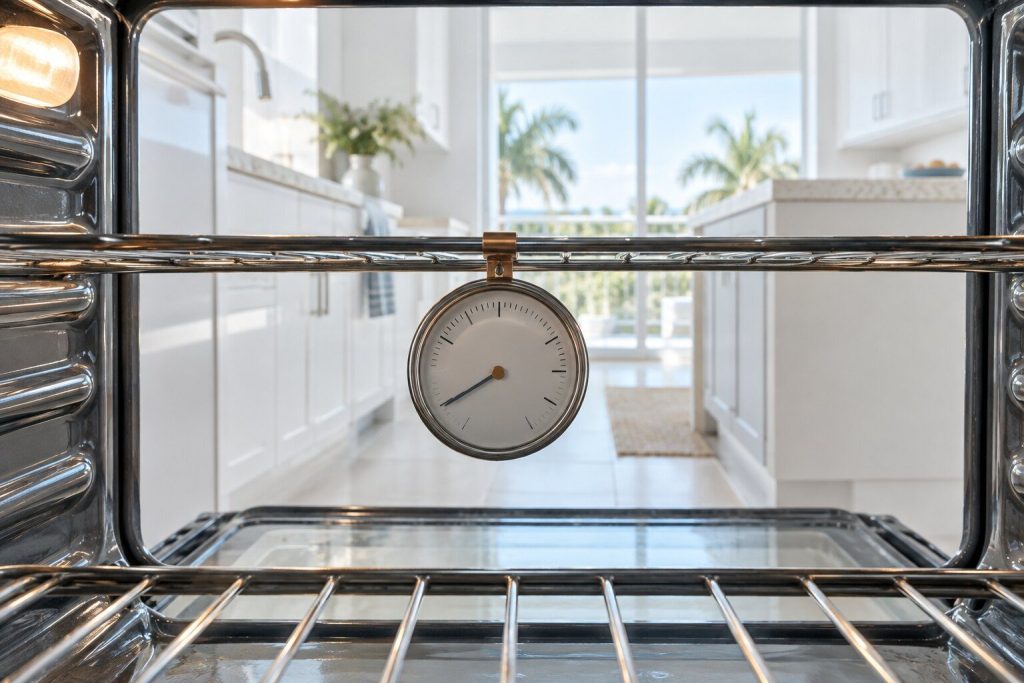
  • A round dial oven thermometer hanging from the middle rack inside a lit oven cavity, its needle plainly low on the dial, the door open into a bright kitchen.
    Cakes sink, edges burn, everything takes longer than the recipe

    Oven temperature is wrong

    Sometimes a failure, sometimes an oven behaving correctly and a recipe written for a different one. These cavities are allowed to swing either side of the setting as the thermostat cycles, and a new oven often runs truer — and hotter at the edges — than the twenty-year-old machine it replaced. A thermometer and three readings settle which of those you have.

    • A cavity swings by design; the question is where the middle of the swing sits
    • A drifting sensor is a part; a small consistent error is a calibration offset
    • A door that leaks heat produces exactly this with nothing electrical wrong
    What it usually means
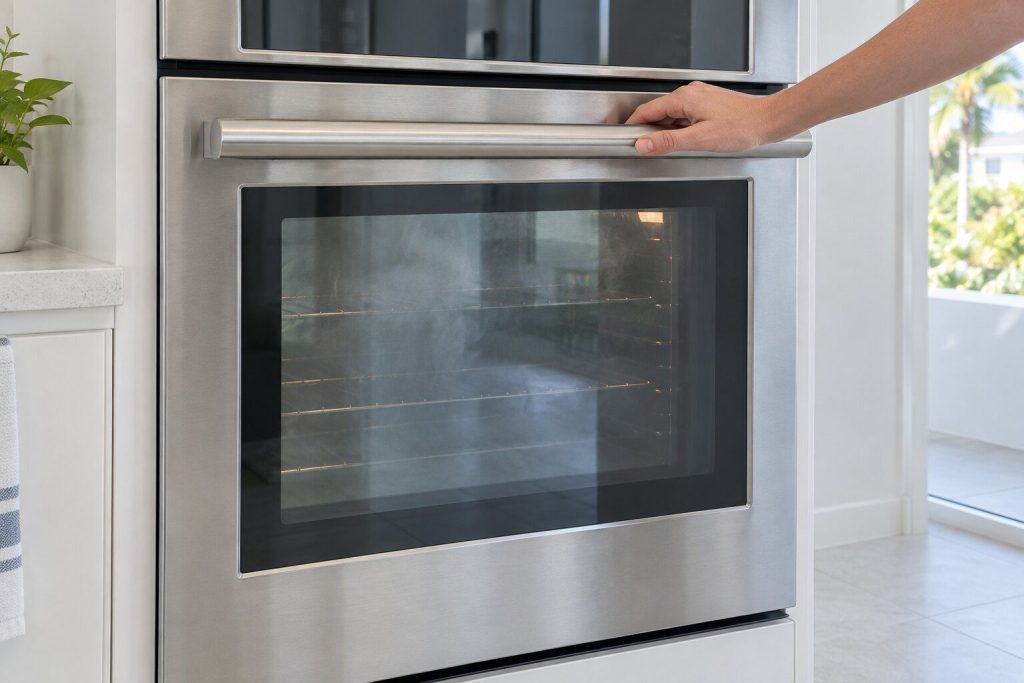
  • The closed door of a stainless wall oven with a hand resting on the bar handle and the door plainly not moving, faint haze on the inside of the glass from a cleaning cycle.
    It went into a clean cycle and never let go

    Oven door locked shut

    Alarming and usually ordinary. The cavity has to fall below a threshold before the lock will release, so a sensor reading high — which is common after the heat of a self-clean cycle — keeps a perfectly good door shut indefinitely. The one thing not to do is lever it, because the hinges and the lock assembly cost several times what the visit does.

    • The lock is waiting for a temperature, and it may be reading the wrong one
    • Forcing the door costs hinges and a lock assembly
    • Self-clean cycles are hard on these ovens, and we say so
    What it usually means
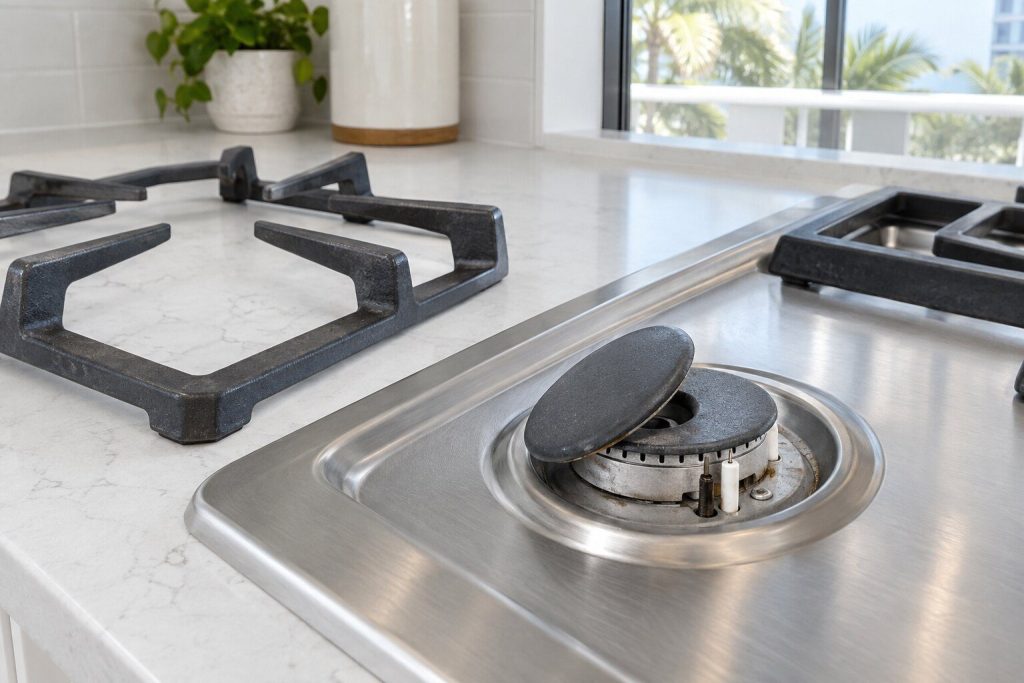
  • One burner of a stainless gas cooktop with its cast grate lifted off and set beside it, the burner cap sitting visibly askew on the burner head and no flame anywhere.
    It clicks and clicks, or lights and goes straight out

    Gas burner will not light

    Mostly mechanical and mostly free to correct: a burner cap put back a few millimeters out after cleaning, a blocked port, or an igniter still wet from a boil-over. The pattern tells us which — one burner or all of them, clicking or silent, lighting then dying — and each of those points somewhere different.

    • A cap out of position after cleaning is the commonest cause of all
    • All burners clicking at once is one stuck switch, not four failures
    • Lighting then going out is the flame sensor or the valve, not the igniter
    What it usually means
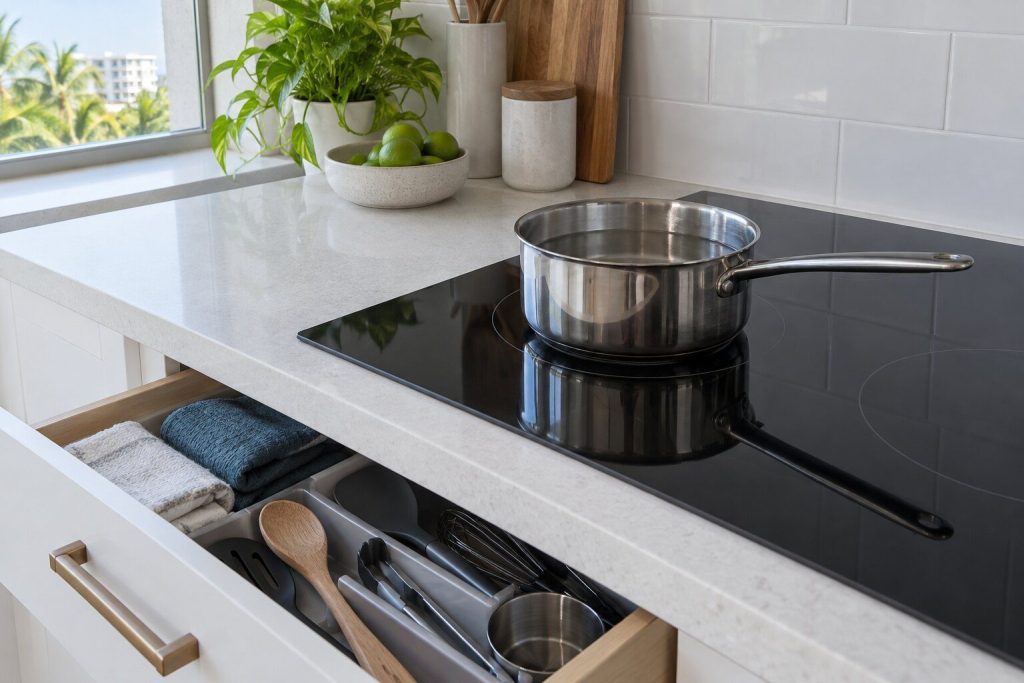
  • A stainless pan of water standing on a black ceramic induction cooktop with the zone beneath it plainly unlit and the pan no longer steaming, a drawer beneath the counter pulled slightly open and packed full.
    It beeps, or a zone stops working part way through cooking

    Induction zone turns itself off

    Frigidaire sells twelve induction ranges and eight induction cooktops, so this is ordinary work rather than an exotic call — and most of it turns out to be the pan or the cooling rather than the hob. An induction zone stops for three reasons: it cannot see a suitable pan, it is too hot inside, or the power board has genuinely failed.

    • Most 'failures' are cookware: the base must be ferrous and cover enough of the zone
    • Induction makes its heat in the electronics, so its cooling fan matters
    • One zone dead and the whole hob dead are different parts
    What it usually means

Why the symptom comes first here

Half of these machines never say anything

This maker documents error codes for the top-load washer, the dishwasher, the electric range and cooktop, and the refrigerator. For its dryers, its freezers, its wine cabinets and its ice machines it publishes nothing at all — no table, no list, no article.

So on those machines there is nothing to look up, and the diagnosis starts from behavior and measurement: a thermometer left in overnight, a meter at the terminals, the run time listened to rather than read. These pages are written for that, and they say when a machine is not going to tell you anything.
Freezer not freezing
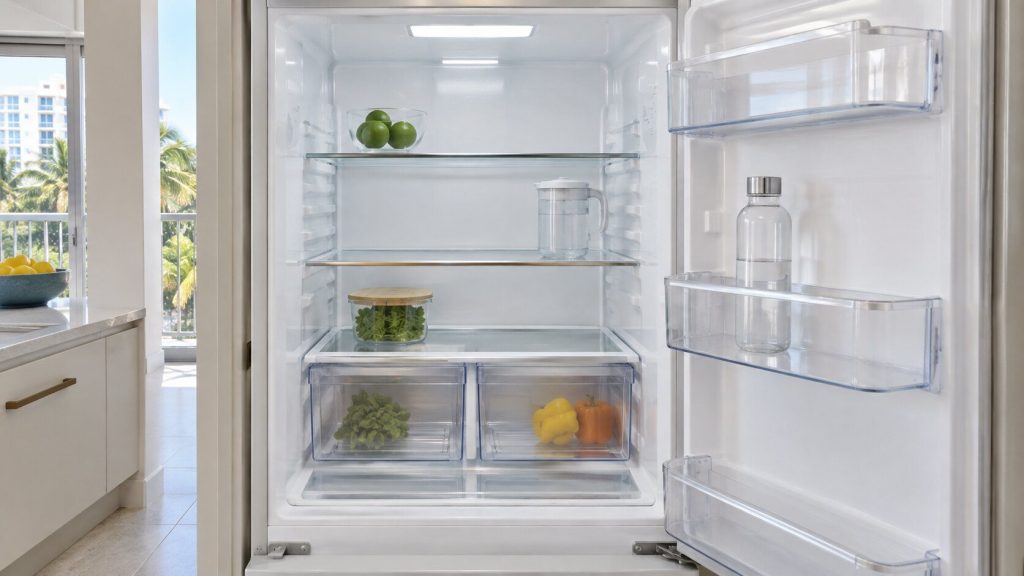
The lit interior of a clean, nearly empty white refrigerator seen straight on with its door open, glass shelves and clear drawers.

And the other half

Where there is a code, it is usually short

Nothing on this make alternates between halves and nothing arrives in two parts. The codes are single and short — F30, i20, E4, and a few two-letter words like Hd and SB — so what the panel shows is the whole of it.

What is worth knowing is that the maker’s own answer to most of them is thirty seconds at the breaker. That is worth doing once, and it is also how the evidence gets thrown away: photograph the display first.

The code archive
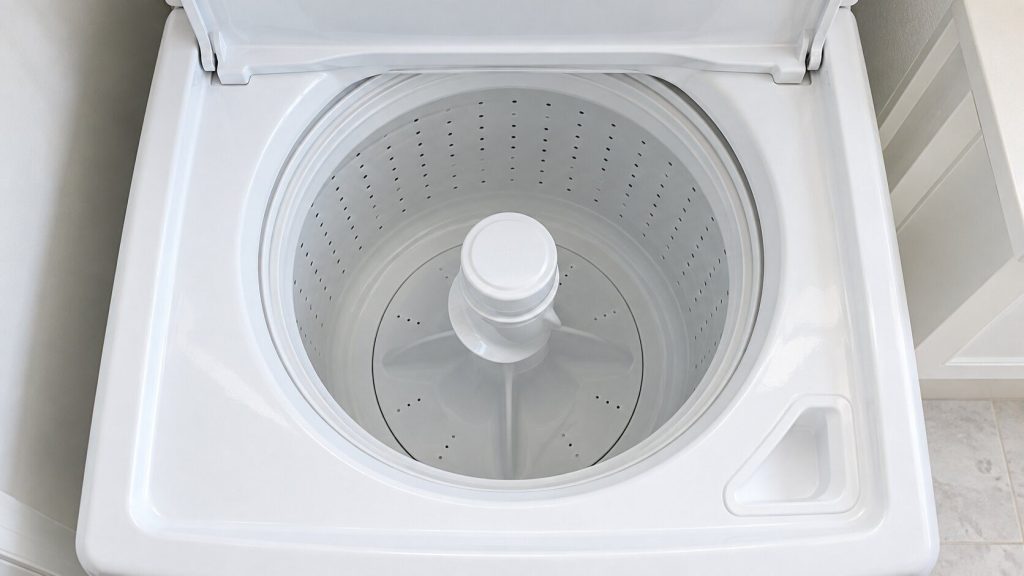
The empty white plastic tub of a top-load washing machine seen straight down through its raised lid, bright daylight.

Before you book

Three minutes that change the visit

If the machine shows something

  • Photograph it. On this make there is no way to ask the appliance for a code again once it has been cleared.
  • Copy the characters exactly, including letters. Hd is not HD and i20 is not I20 on the page you are looking for.
  • Note which appliance it is on. The same characters mean different things on a washer and on a range.
  • Do it before you cut power, not after.

If it says nothing at all

  • On anything that makes cold, leave a thermometer in a glass of water overnight and read it before the door is opened.
  • Listen to whether the compressor is running constantly, cycling, or not running. You can hear which without any tools.
  • Look for frost where there should be none — it is the clearest evidence a quiet cabinet gives.
  • On laundry, note which stage of the cycle it fails at. That single fact narrows it more than anything else you can tell us.

Or start from the machine

By appliance instead

If you would rather begin from what it is than from what it is doing.

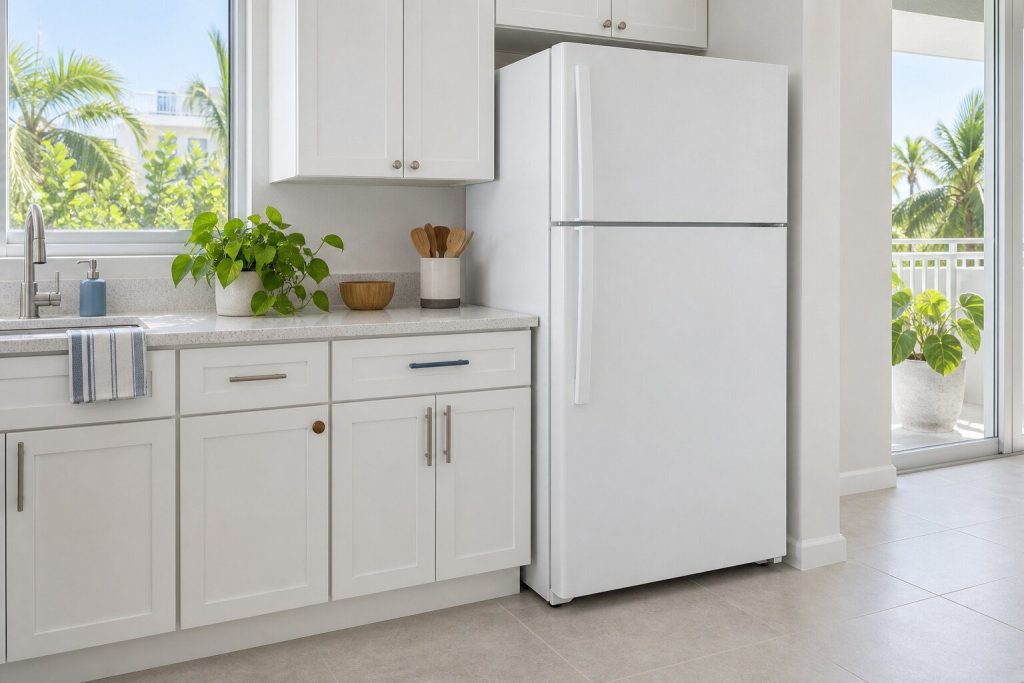
  • A white two-door top-freezer refrigerator standing at the end of a run of plain white builder cabinets in a bright condominium kitchen, freezer door above and fresh-food door below, plain flat handles.
    Top freezer · French door · side by side

    Refrigerators

    The deepest branch of this catalog by a distance: 142 cabinets, and the largest single family in everything Frigidaire currently sells is the plain top-freezer refrigerator — 55 of them. That number is the brand in one line. This is the refrigerator that came with the apartment, and half our calls are for a cabinet nobody chose. French door adds 44 and side-by-side 31, which is where the ice and water go wrong, and the two-cabinet compact and bottom-freezer families are small enough to name individually. In this climate the work concentrates on defrost, on door seals that never fully dry, and on condensers that live in salt air.

    • 142 cabinets across five layouts — top freezer is the biggest family in the catalog
    • French door and side-by-side bring the ice and water circuits most calls are about
    • Defrost, seals and condensers do most of the failing in South Florida
    Refrigerator repair
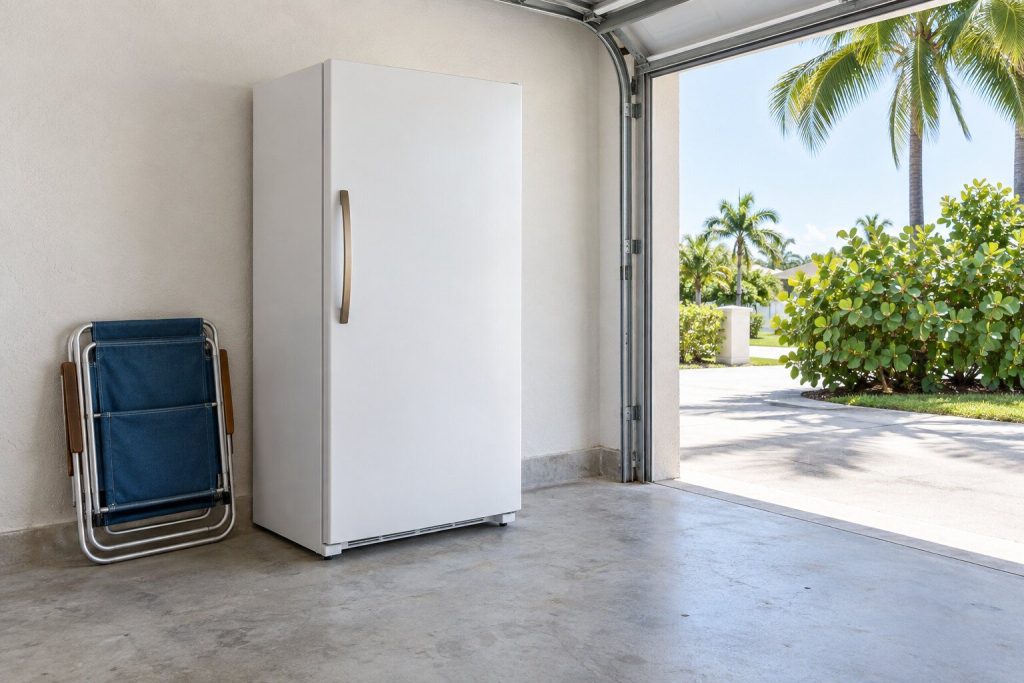
  • A single-door white upright freezer standing against a pale stucco garage wall beside a folded beach chair, its door closed, a concrete floor and bright daylight through an open roller door with palms and a driveway beyond.
    Upright · chest · single door

    Freezers

    Twenty-seven cabinets, and unusually for a volume brand the upright is the bigger half — 17 against three chest freezers and a small single-door family. In South Florida a standalone freezer usually lives in a garage or a utility room rather than a kitchen, which changes both what goes wrong and what a visit involves: ambient temperature well above what the cabinet was rated for, a condenser breathing dust, and a door that gets opened with wet hands in August. A freezer that is quietly running warm is the failure that costs the most, because nothing announces it until the food is gone.

    • 27 cabinets — 17 upright, three chest, the rest single-door
    • Most of them live in a garage, at an ambient the cabinet was never rated for
    • Running warm is the expensive failure: nothing tells you until the food does
    Freezer repair
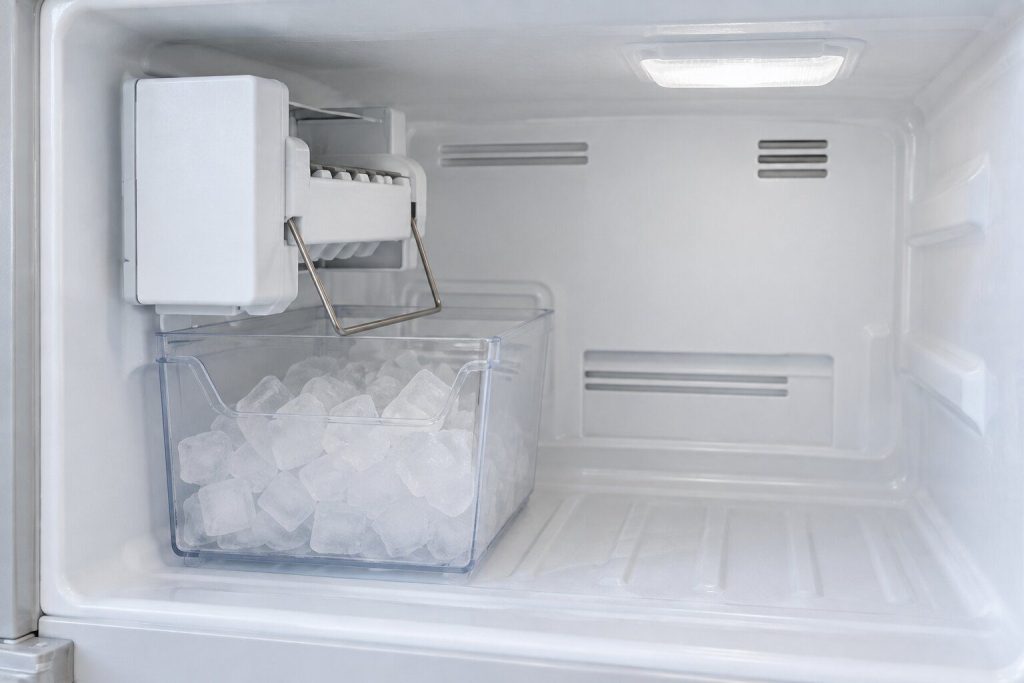
  • The inside of a top-freezer compartment with its door open, a white plastic ice maker module mounted on the left wall with its wire shut-off arm in the down position and a clear bin of cubes below it.
    In the refrigerator · in the freezer door

    Ice makers

    This page is about the ice maker inside the refrigerator, because that is where Frigidaire puts them. The catalog has no undercounter ice cabinet at all — the standalone machines are three countertop appliances, and they have their own page. What we are called out for here is the module in a French door or side-by-side cabinet: no ice, hollow or half-formed cubes, a bin that has frozen into one block, or a dispenser that grinds and delivers nothing. The water side of that circuit — filter, valve, line — causes more of it than the module itself.

    • The module inside the refrigerator, which is where this make puts it
    • No ice, hollow cubes, a frozen bin and a dispenser that grinds — one circuit, four faces
    • The problem is on the water side more often than in the ice maker
    Ice maker repair
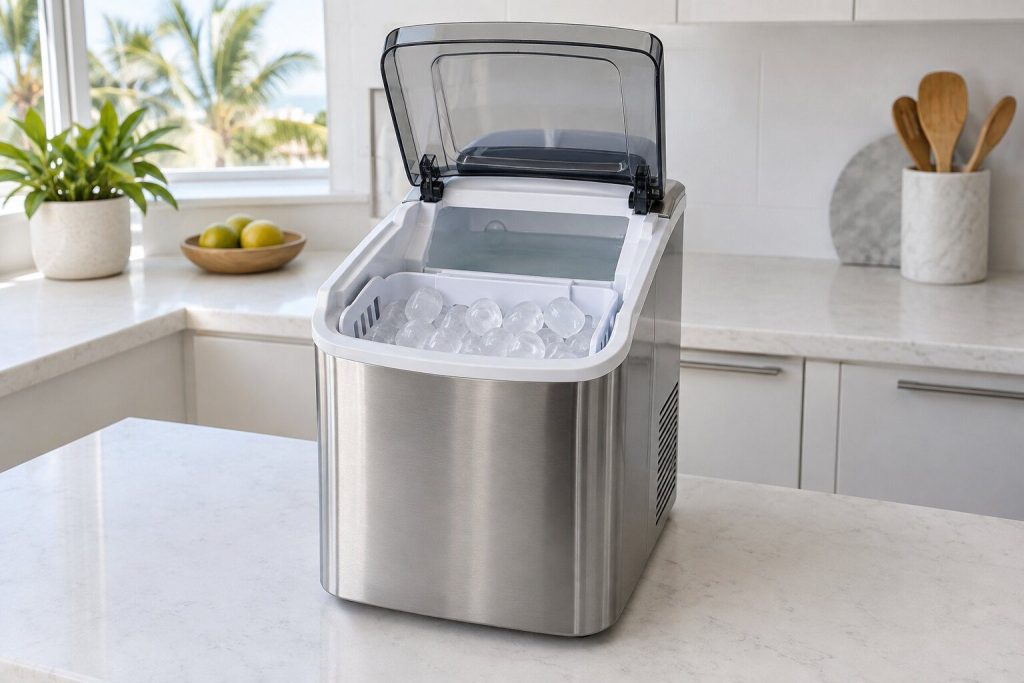
  • A small stainless countertop ice-making machine the size of a coffee maker standing on a light quartz counter with its top lid open, showing a shallow water reservoir and a basket of clear bullet-shaped ice.
    Countertop · portable · bullet ice

    Ice machines

    Three models, all of them countertop: a portable machine you fill from a jug that makes bullet ice in a few minutes. It is worth being exact about that, because the phrase 'ice machine' means an undercounter cabinet with a drain and a condenser on other makes in this trade, and Frigidaire builds none. These are small appliances with a pump, a compressor, an evaporator of steel fingers and a water reservoir, and they fail in small-appliance ways: scale, a pump that has lost prime, a sensor that thinks the basket is full.

    • Three countertop machines — this make builds no undercounter ice cabinet
    • Bullet ice from a filled reservoir, not a plumbed circuit
    • Scale, pump priming and the full-basket sensor cause most of it
    Ice machine repair
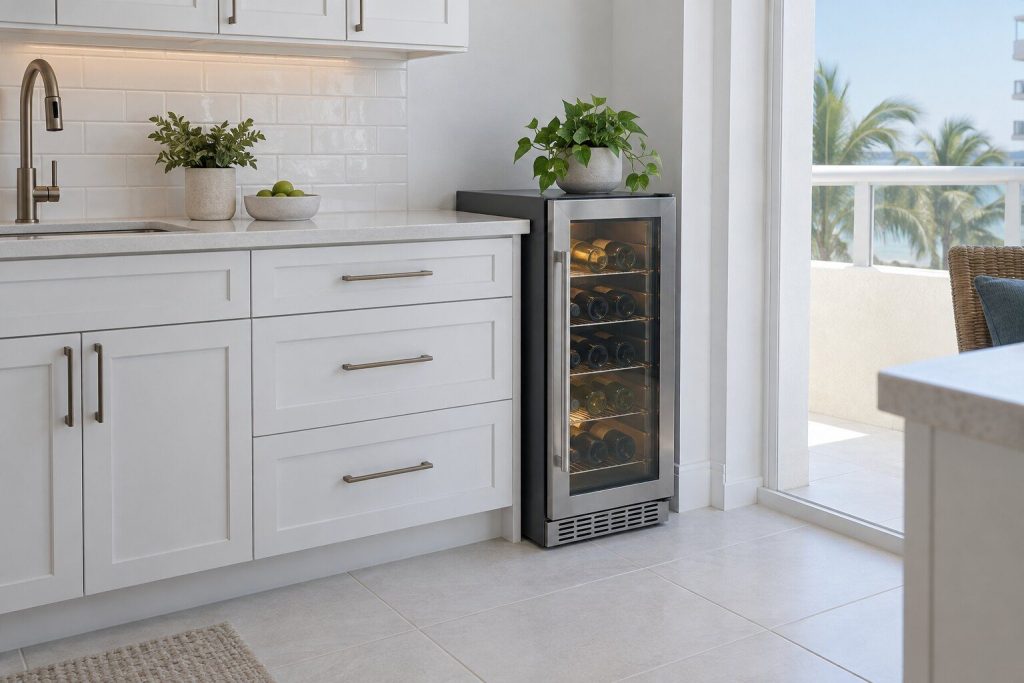
  • A narrow freestanding beverage and wine cooler with a single glass door and wire shelves of bottles lying flat, standing at the end of a light kitchen run against white cabinets.
    Beverage centers · wine storage

    Wine and beverage coolers

    Seven cabinets, and they are beverage centers and wine storage rather than the multi-zone cellars the luxury makes in this fleet sell. They go under a counter or into a bar run, they are usually glass-doored, and in South Florida they spend the year fighting the room: warm ambient, a glass door that gains heat, and a compressor sized for a small cabinet. The complaints follow from that — not holding temperature in the afternoon, condensation on the inside of the glass, a fan that has become loud.

    • Seven cabinets — beverage centers and wine storage, not multi-zone cellars
    • A glass door in a warm room is the whole thermal problem in one part
    • Not holding temperature, condensation and fan noise are the three calls
    Wine cooler repair
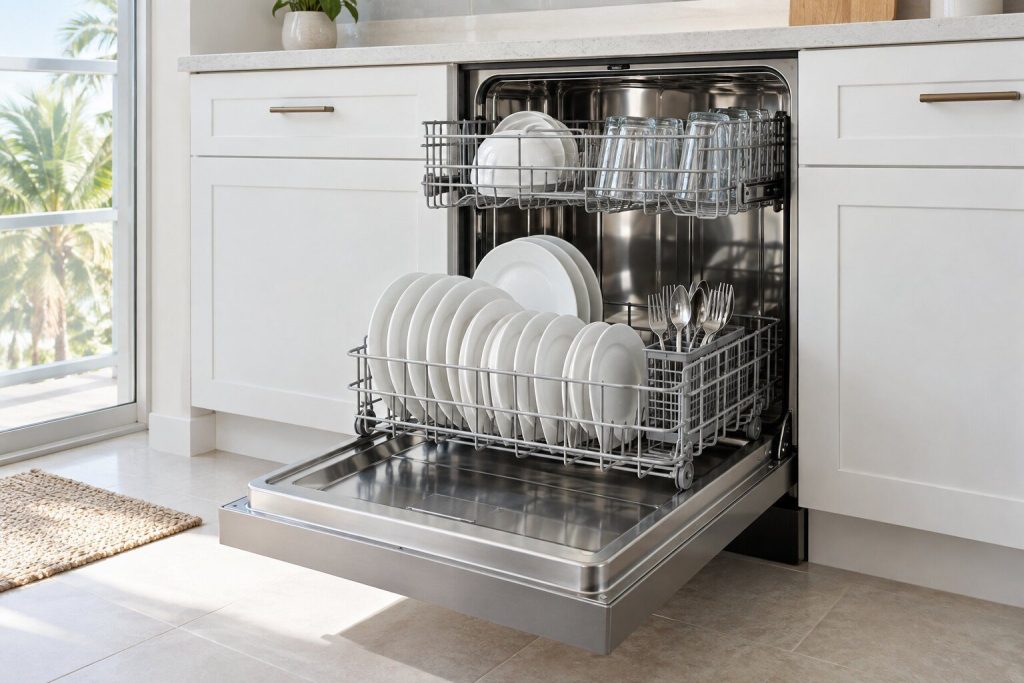
  • A stainless front-control dishwasher built into a white cabinet run with its door dropped open and both racks pulled out, plain white plates and glasses loaded, a stainless tub interior.
    Built-in · front control · plastic and stainless tub

    Dishwashers

    Thirty-six machines, from the plain front-control model that fills a builder's kitchen to the Gallery and Professional trims with a third rack. This is the appliance where the difference between series is smallest: the same platform, a different fascia and a quieter tub. What we attend is consistent because of that — not draining, not cleaning, not drying, and water where it should not be. The filter and the spray arms account for more of it than any electrical part does, which is why the first questions are about what is at the bottom of the tub.

    • 36 machines across three trims on much the same platform
    • Not draining, not cleaning, not drying, leaking — four complaints, one machine
    • The filter and the spray arms explain more calls than any board ever does
    Dishwasher repair
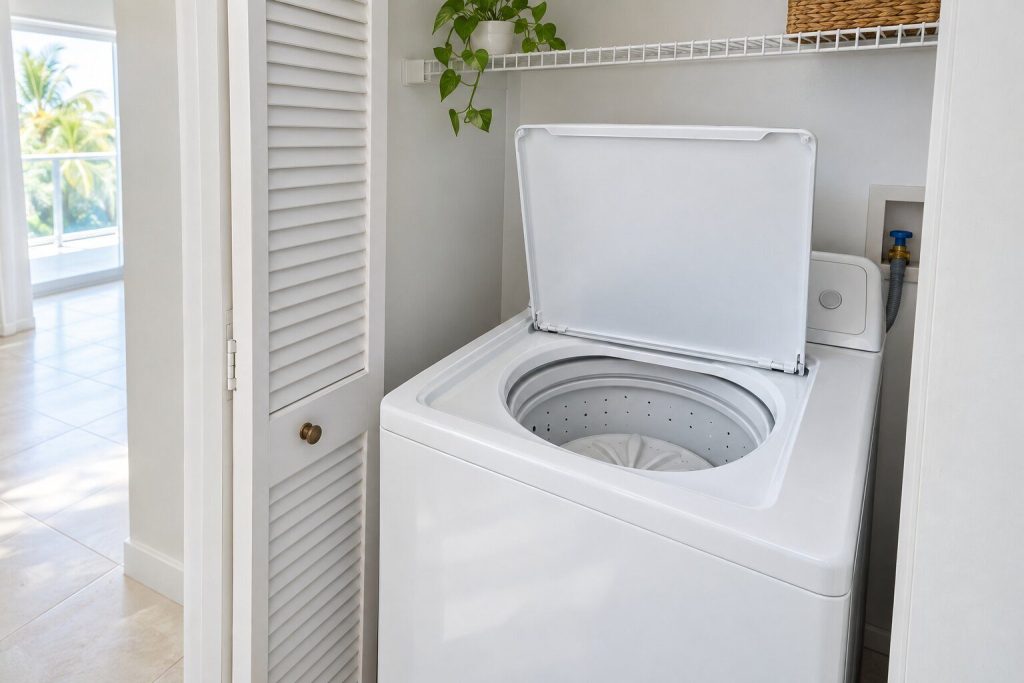
  • A white top-load washing machine standing in a bright laundry closet with its lid raised, showing an empty white plastic tub and a shallow impeller plate in the bottom.
    Top load · front load · laundry centers

    Washers

    The current catalog carries two top-load washers and three laundry centers, and that thinness is worth saying out loud: Frigidaire's laundry line today is a fraction of its kitchen line. What we open in South Florida is mostly older — front-loaders from the years the badge sold them in volume, top-loaders in condominium closets, and stacked laundry centers in apartments where nothing else fits. The failures are the ones that come with age and with this climate: bearings, seals that never dry, pumps that meet a lint load nobody clears, and drains that back up in a shared stack.

    • Nine current laundry machines in the whole catalog — two of them washers
    • Most of what we service is older, and stacked centers are normal in condominiums
    • Bearings, door seals, pumps and shared drains do the failing here
    Washer repair
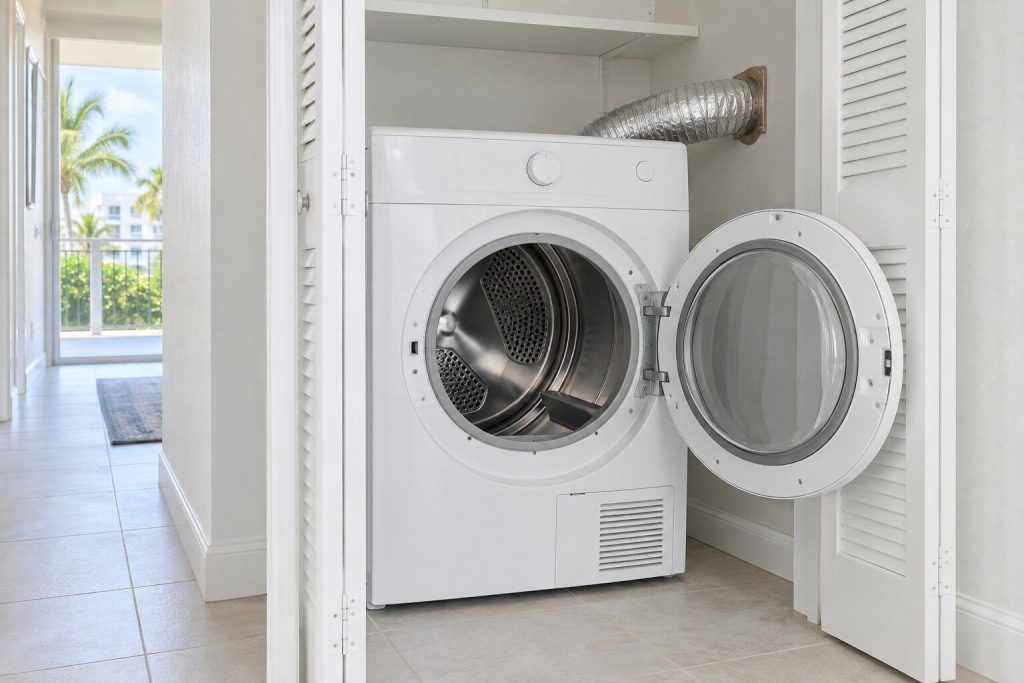
  • A white front-loading vented dryer in a narrow laundry closet with its door swung open, an empty stainless drum inside and a flexible foil duct visible behind the machine going into the wall.
    Electric · gas · stacked centers

    Dryers

    Four dryers and three laundry centers in the current line, and every one of them vented — there is no heat-pump dryer under this badge. In South Florida the vent is most of the story: a duct that runs further than it should, through a wall into a corridor or up through a building, collecting lint at every bend. A dryer that takes two cycles to dry a load is almost never a broken dryer, and saying so before selling a part is the difference between a repair and a sale. The genuine problems, when they come, are the element or the burner, the thermostat and the cutout, the drum rollers and the belt.

    • Every dryer here is vented — no heat-pump machine under this badge
    • Long duct runs and lint explain more slow-drying calls than any part does
    • Element or burner, cutouts, rollers and belt are the real failures
    Dryer repair

Worth saying

Several of these end with us telling you not to book

A dishwasher leaving plastics wet is drying by condensation and is working correctly. A washer that stops with a soaked load has been overruled by its own balance logic, usually by one comforter. A cabinet with no lights and a dead panel is often in Sabbath mode. We would rather write those down than take money for showing you a setting, and the pages say so where it applies.

Before you book

The questions this page is asked

My problem is not on this list.

Call and describe it. Twenty-six pages is what we have written up rather than what we take on, and a behavior that is not here is a gap in our writing rather than in our work.

Two things are wrong at once.

Say both when you book. A washer that leaks and will not spin is not two visits, but it is a different set of parts on the van than either alone, and knowing in advance is what keeps it to one.

The machine cleared its own message. Have I lost anything?

Some of it. On this make there is no service display to ask for it again, so if the behavior is still there we work from what the machine does rather than from what it said.

In more detail

Why this archive matters more on this make than on most

Five kinds of machine that never say anything

This maker documents no error code at all for its dryers, its freezers, its wine cabinets or its ice machines. On those appliances there is nothing to look up, and the diagnosis is a thermometer, a meter and listening to what the machine is doing. These pages are written for that.

What is free, and said first

Each page opens with the checks that cost nothing, because on a volume badge a surprising share of calls end at a control lock, a filter, a level or a setting. We would rather write those down than be paid to point at them.

Ours and the maker’s, kept apart

Where a condition is documented, the maker’s own sentence is quoted and attributed. The reading around it — what it tends to mean in a building on this coast, with this humidity and this water — is ours, and it is written per page rather than repeated.

Describe it in one sentence.

What it does, when it does it, and what the panel shows if anything. That is usually enough for us to name the likely part before anybody sets off.

This article is based on:

  • Official manufacturer documentation
  • Internal repair procedures
  • Technician repair history
  • Company quality standards
Call (305) 615-5496