Safety & Risks
How Long Food Is Safe in the Fridge and Freezer Without Power
About four hours in a refrigerator, with the door kept closed the whole time. A full freezer holds safe temperatures for roughly forty-eight hours and a half-full one for about twenty-four, again unopened. Those figures assume the door stays shut, and that is the part people get wrong — every check spends part of the budget, and a refrigerator opened three times during a four-hour outage does not get four hours. Afterwards, judge the freezer by ice crystals rather than by feel: anything still holding visible crystals can safely be refrozen, though the texture may suffer. In the refrigerator, anything perishable that has been above forty degrees for more than two hours should go, however good it looks and smells, because the bacteria that matter do not announce themselves. When in doubt the rule is the old one and it is right: throw it out.
The full guide
How many hours is food safe in a fridge without power is the one question on this site where the answer matters more than any repair, and in this county it comes up every summer.
How many hours is food safe in fridge without power? The numbers
Refrigerator: about four hours, with the door kept closed.
Full freezer: about forty-eight hours. Half-full freezer: about twenty-four.
A full freezer holds twice as long as a half-empty one for a simple reason — frozen food is its own cold store, and a packed cabinet has far more of it. This is why filling the empty space with bottles of water before storm season is worth doing: it costs nothing and it doubles your margin.
The mistake almost everyone makes
Those figures assume the door stays shut. Not mostly shut. Shut.
Every opening dumps the cold air out and pulls warm, humid Florida air in, and in a refrigerator that air is most of what is holding the temperature. A cabinet opened three times during a four-hour outage does not get four hours — it may get two.
The instinct during an outage is to keep checking, and the checking is what spends the budget. Decide at the start what you need out of it, take that in one opening, and then leave it alone.
Afterwards: ice crystals, not judgment
For the freezer, the test is physical and it is reliable: visible ice crystals. Anything still holding them can be refrozen safely. The texture may suffer — a refrozen loaf or a bag of berries will not be what it was — but it is not a safety question.
Anything that has thawed completely and been above forty degrees for over two hours goes.
For the refrigerator, the rule is time and temperature rather than inspection. Meat, poultry, fish, dairy, eggs, cooked leftovers, cut fruit and anything containing them: above forty degrees for more than two hours, discard.
What survives: hard cheeses, butter, most condiments, whole uncut fruit and vegetables, jams, and unopened shelf-stable items that happened to be in there.
Smell is not a test
This is worth being blunt about because it is the most common thing people rely on.
The organisms that cause food poisoning frequently produce no smell, no change in appearance and no change in taste. The ones that make food smell bad are often harmless spoilage bacteria. So a container that smells fine can be dangerous and one that smells sour can be merely unpleasant.
Time and temperature are the test. Nothing else is.
The trick that tells you what happened while you were out
Worth setting up once, before the next storm.
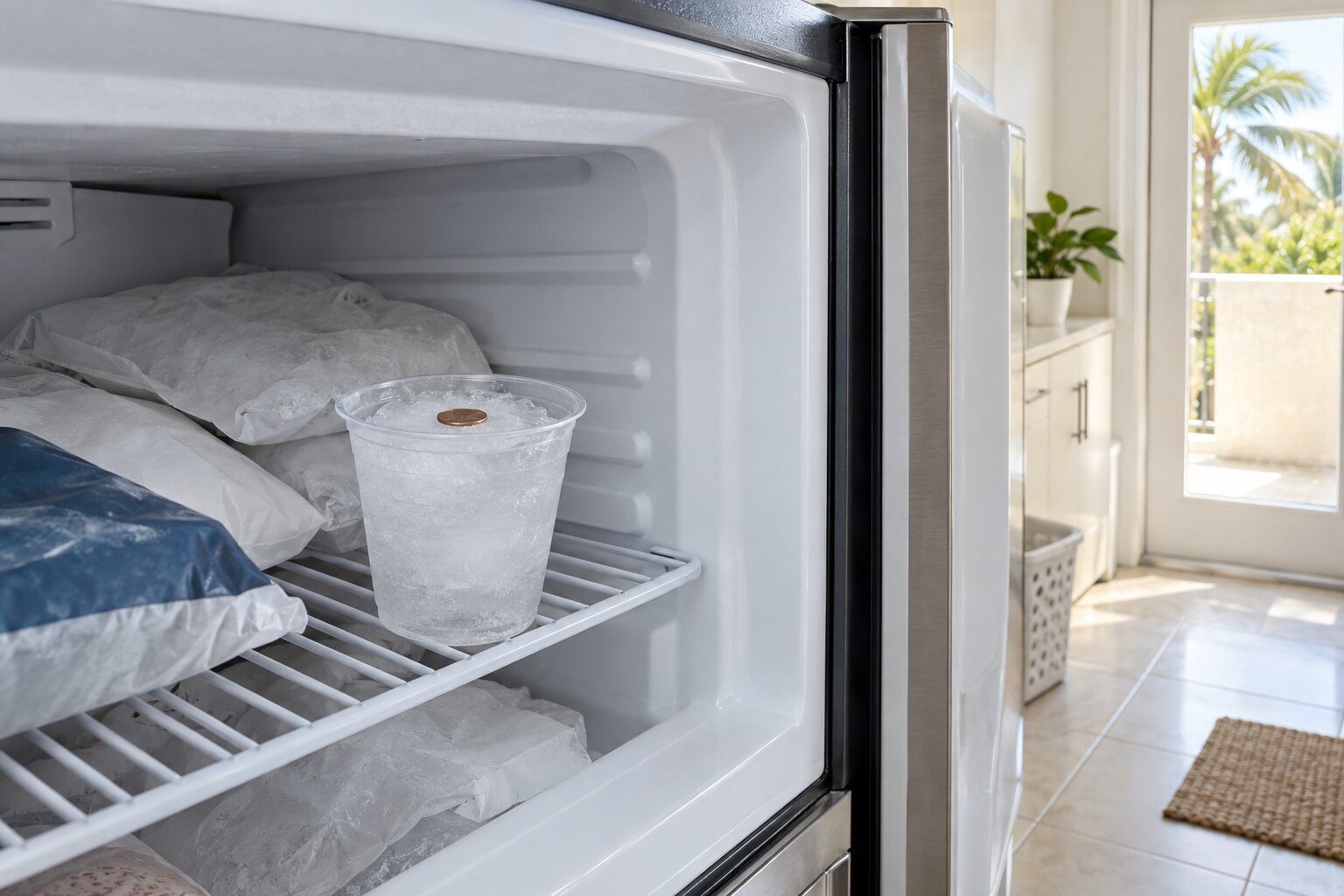
Freeze a cup of water solid. Put a coin on top of the ice. Leave it in the freezer.
If you come back and the coin is still on top, the freezer stayed frozen. If it is at the bottom of the cup, the contents thawed completely and refroze — and everything in that freezer should be treated as thawed, regardless of how solid it feels now.
It costs nothing and it answers a question you otherwise cannot answer at all.
What the appliance will and will not tell you
On a refrigerator, this maker publishes a high-temperature alert — H or HI — and it does something genuinely useful: when you acknowledge the alarm, the display shows the highest temperature the cabinet reached. Write that number down before clearing it, because clearing it discards it, and it is the single most useful fact about what happened while the power was off.
On a freezer, there is nothing. This maker publishes no codes at all for any freezer it builds, so the cabinet cannot tell you anything and the ice-crystal test and the coin are what you have.
Before the season, four things
Fill the freezer. Bottles of water in the empty space, frozen. They double the holding time and they thaw into drinking water.
Set a thermometer in each cabinet now. Thirty-seven degrees in the fresh-food section and zero in the freezer is what this maker recommends, and knowing where you start decides how much margin you have.
Clean the condenser coil. A cabinet that was struggling before the outage recovers more slowly afterwards, and in this territory the coil behind the floor-level grille loads within a year or two.
Check the door seal with the dollar-bill test. A cabinet that leaks warm air continuously has less margin on an ordinary day and much less on a hot one with no power.
If it turns out to be a repair
What this leads to, and what it costs
Every job on this site is priced the same way: an on-site diagnostic first, the figure agreed in writing before anybody starts.
-
Freezer not freezing
The expensive failure, because nothing announces it. A freezer that has drifted from 0°F to 20°F looks and sounds exactly like one that is working, and the first sign is usually the food. In South Florida there is an extra suspect that is not the machine's doing at all: a cabinet in a garage is being asked to work at an ambient it was never rated for.
- Nothing tells you until the food does — a thermometer is the whole early warning system
- A garage in August is not the room the cabinet was designed for
- Upright and chest freezers fail in different places, so say which you have
-
Refrigerator not cooling
The cabinet is doing something — you can hear it — and it is still not cold. On most of the machines this badge sells there is nothing on the front to read, so the first useful thing you can do is not a repair at all: put a thermometer in each compartment and note the two numbers an hour apart. That pair tells us more than any description of the noise, and it is the difference between an hour of guessing and a visit that arrives with the right parts.
- A cold freezer with a warm fridge is an air problem, not a refrigerant one
- Both halves drifting together is the dearer diagnosis, and worth knowing before we arrive
- Three free things — a blocked vent, a stuffed condenser, a door held ajar — end a real share of these
-
Refrigerator error code H
Frigidaire refrigerator error code H: The cabinet has been warmer than it should be for long enough to say so out loud, and the maker's own list of causes is the honest one: a door left open, a setting somebody changed, a seal that no longer closes. Which machines can raise it, what the maker publishes about it, and what to do next.
What this one means
Questions people ask about this
How many hours is food safe in a fridge without power if I add ice?
Bags of ice in the fresh-food section extend it usefully, and dry ice extends a freezer considerably — but add it early rather than late, in one opening, and then leave the door shut. Adding ice repeatedly is worse than adding none.
Can I tell by smell whether food is still good?
No, and this is the part worth being firm about. The organisms that cause food poisoning do not necessarily change the smell, the look or the taste of anything. Time and temperature are the test, not your senses.
Tell us the model number and what it is doing.
This article is based on:
- Official manufacturer documentation
- Internal repair procedures
- Technician repair history
- Company quality standards