Common Problems
A New Frigidaire Refrigerator Takes Longer to Get Cold Than You Think
Expect the fresh-food side to feel properly cold after about four hours and the freezer to reach zero within eight to twelve, but do not judge the cabinet until it has run for twenty-four hours with the doors kept shut and no food in it. In a Florida kitchen in summer — and especially in a unit that has been closed up, or where the delivery happened on a hot afternoon — the longer end of that is normal rather than a sign of trouble. Ice takes longer still: the first cubes usually appear between twelve and twenty-four hours after the water line is connected, and the first two or three batches should be thrown away. If the freezer has not reached zero after a full day with the doors closed, that is the point at which the wait has stopped being normal.
The full guide
How long does a new Frigidaire refrigerator take to get cold is one of the few questions on this site where the honest answer is *wait, and do nothing*.
How long does a new Frigidaire refrigerator take to get cold? The clock
About four hours and the fresh-food section will feel cold to a hand.
Eight to twelve hours and the freezer should be at or near zero.
Twenty-four hours before anyone judges it. That is the number that matters. Pull-down is not a single event, it is the cabinet removing the heat from its own walls, shelves, liner and insulation, and that takes considerably longer than cooling the air inside it.
Twelve to twenty-four hours after the water is connected before the first ice arrives, and the first couple of batches go in the sink — they carry the taste of a new line and a new mold.
Why it is slower here than the manual suggests
Three local reasons, and all of them are ordinary.
The room. Pull-down times are quoted for a kitchen around seventy degrees. A South Florida kitchen in August is not that, and a unit that has been shut up between tenancies can be well into the eighties when the delivery arrives. Every degree of that is heat the cabinet has to move before it starts on the food.
The delivery. A machine that has spent two hours in a truck in the sun starts its pull-down warm all the way through — walls, liner, shelves and all.
The doors. This is the one people do to themselves. Opening the door every half hour to see whether it is getting cold resets a good part of the progress each time, because what comes in is warm, wet Florida air that then has to be dried onto the evaporator before anything else happens.
What is normal on day one and looks alarming
A few things that generate calls and should not.
The cabinet runs constantly. It is meant to. A refrigerator pulling down does not cycle; it runs until it arrives. Constant running on day one is correct, and constant running on day five is not.
The sides feel warm. On many of these the condenser tubing runs through the cabinet walls. Warm sides during pull-down are the machine getting rid of heat, which is what you want.
Water inside. Condensation on the interior walls in the first hours is the humid air that came in with the food and the packaging. It clears.
Noises you have not heard before. A new cabinet is not quieter than the old one, it is *differently* noisy — expansion ticks, the fan, water dropping onto the defrost heater. Give it a week before deciding a sound is a problem.
The two-hour rule about standing it upright
If the machine traveled lying down — and plenty do — leave it standing upright and unplugged for at least four hours before switching it on, and overnight if you can.
Compressor oil moves when a cabinet is laid over. Starting the compressor before it has drained back is one of very few ways to genuinely damage a refrigerator that has never been used, and it is entirely avoidable by waiting.
Set it and then leave it alone
Thirty-seven degrees in the fresh-food section and zero in the freezer is what this maker recommends for a kitchen, and those numbers are worth setting on the first day and then not touching.
The temptation during pull-down is to turn the dial colder to speed it up. It does not speed anything up — the compressor is already running continuously and cannot run more than continuously — and what it usually produces is a fresh-food section that ends up freezing lettuce a week later, after the household has forgotten the setting was changed.
When the wait has stopped being normal
One test, and it is the only one that counts.
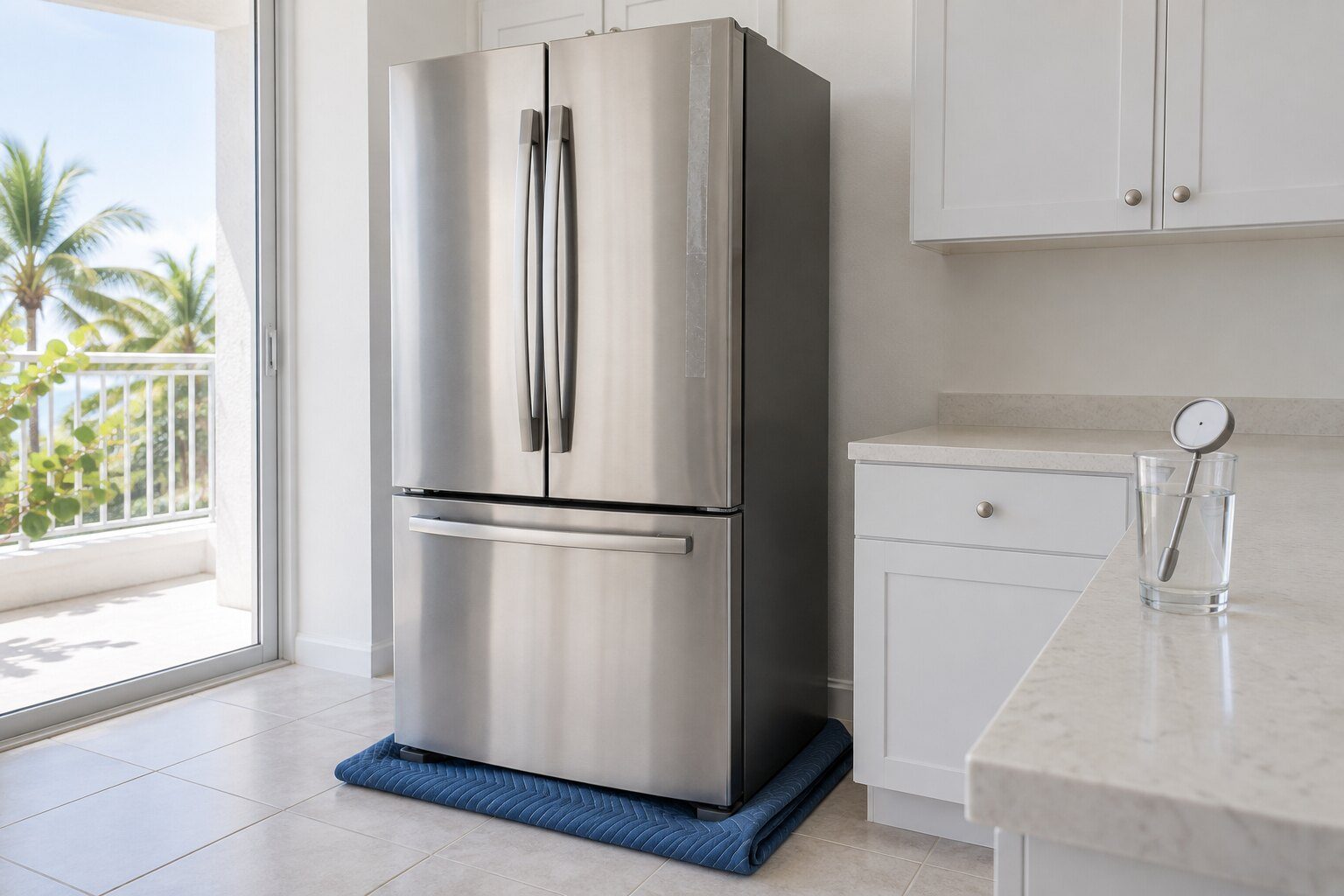
Twenty-four hours after it was switched on, with the doors kept shut and nothing in it, put a glass of water in the fresh-food section and a thermometer in the freezer, and read them.
If the freezer is above zero and the fresh-food side is above forty at that point, the cabinet is not pulling down and it is worth a call. Everything before the twenty-four-hour mark is a machine doing its job in a warm room.
And if it was installed in the last thirty days, tell us that when you call — the installer owns the first month, and on a delivery-plus-fitting arrangement that is often who should be looking at it first.
If it turns out to be a repair
What this leads to, and what it costs
Every job on this site is priced the same way: an on-site diagnostic first, the figure agreed in writing before anybody starts.
-
It runs, the light comes on, and the food is warm Refrigerator not cooling
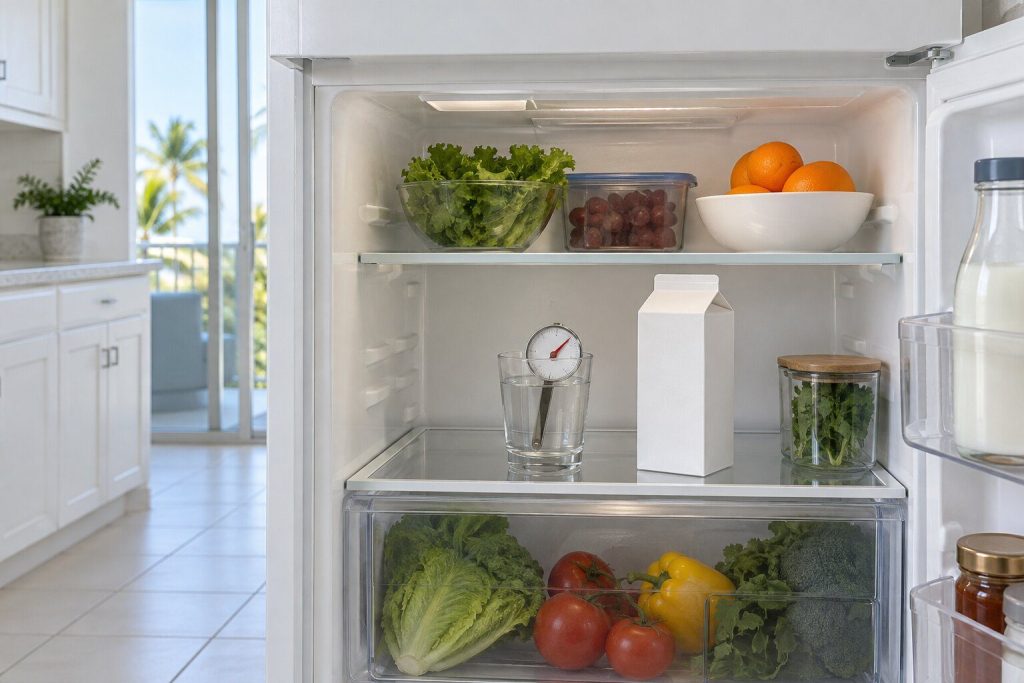
The cabinet is doing something — you can hear it — and it is still not cold. On most of the machines this badge sells there is nothing on the front to read, so the first useful thing you can do is not a repair at all: put a thermometer in each compartment and note the two numbers an hour apart. That pair tells us more than any description of the noise, and it is the difference between an hour of guessing and a visit that arrives with the right parts.
- A cold freezer with a warm fridge is an air problem, not a refrigerant one
- Both halves drifting together is the dearer diagnosis, and worth knowing before we arrive
- Three free things — a blocked vent, a stuffed condenser, a door held ajar — end a real share of these
-
The cabinet is running and the food has gone soft Freezer not freezing
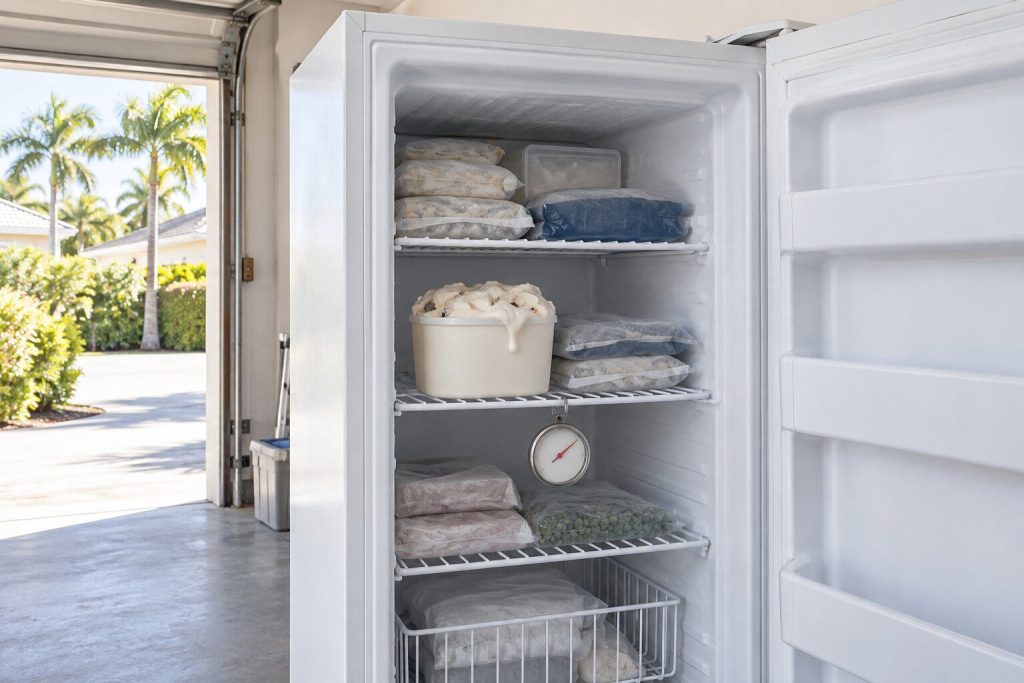
The expensive failure, because nothing announces it. A freezer that has drifted from 0°F to 20°F looks and sounds exactly like one that is working, and the first sign is usually the food. In South Florida there is an extra suspect that is not the machine's doing at all: a cabinet in a garage is being asked to work at an ambient it was never rated for.
- Nothing tells you until the food does — a thermometer is the whole early warning system
- A garage in August is not the room the cabinet was designed for
- Upright and chest freezers fail in different places, so say which you have
-
from $139 Appliance installation
Fitting a new machine properly and leaving the old one gone: level, connected, tested and checked for the things that cause a call-out three weeks later. On this badge most of what we install is freestanding or slide-in, which is straightforward — and the two that are not, a wall oven in a column and a beverage cabinet built into a run, are exactly where a bad installation shows up later as a repair.
- Level, connected, tested — and the old machine taken away
- Water, gas and vent connections left right, not just left working
- Built-in cabinets get a clearance check, which is where later problems begin

Questions people ask about this
How long does a new Frigidaire refrigerator take to get cold if it was delivered on its side?
Stand it upright and leave it unplugged for a few hours before starting it — some say four, some say overnight, and longer is never wrong. Oil that has moved out of the compressor needs to drain back before it runs, and starting it too early is one of the few ways to damage a new cabinet on day one.
Should I put food in straight away?
No. An empty cabinet reaches temperature far faster than a full one, and a load of room-temperature groceries put in during the first hours adds heat the machine is already fighting. Give it the first day empty, then fill it.
Common Problems
More guides like this one
-

Why a Frigidaire Dishwasher Cycle Takes as Long as It Does
Two to three hours is normal, and the reason is heat. The machine waits for its water — about a minute or two of delay for every degree of temperature rise.
Read more -
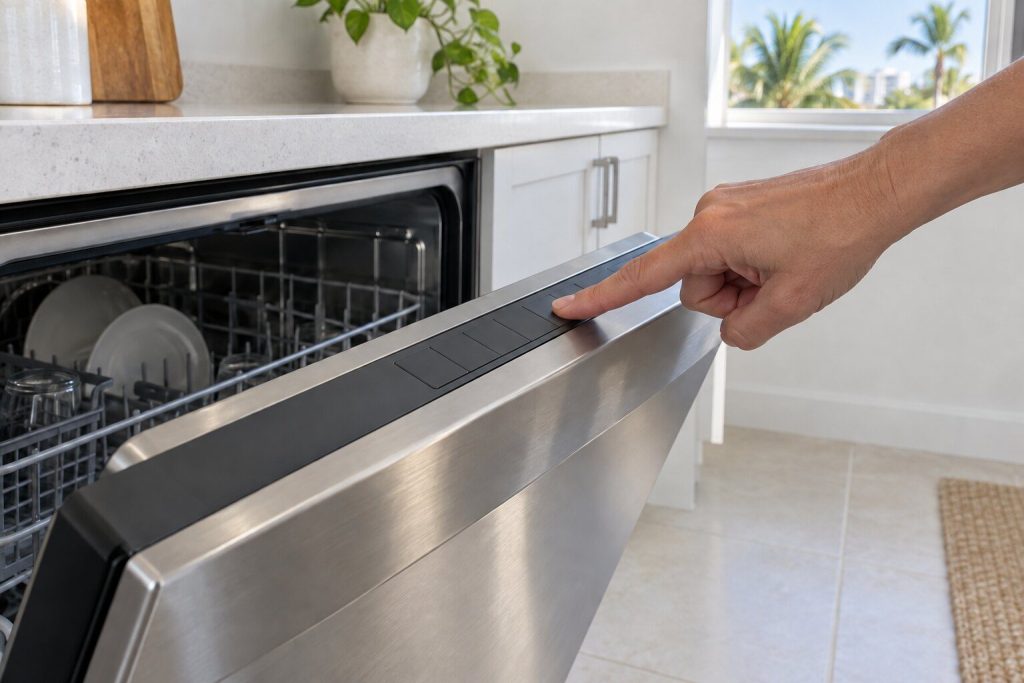
Unlocking a Frigidaire Dishwasher That Is Ignoring Every Button
Three different things get confused here: the control lock, a delay start counting down, and a door latch switch that is not making contact.
Read more -
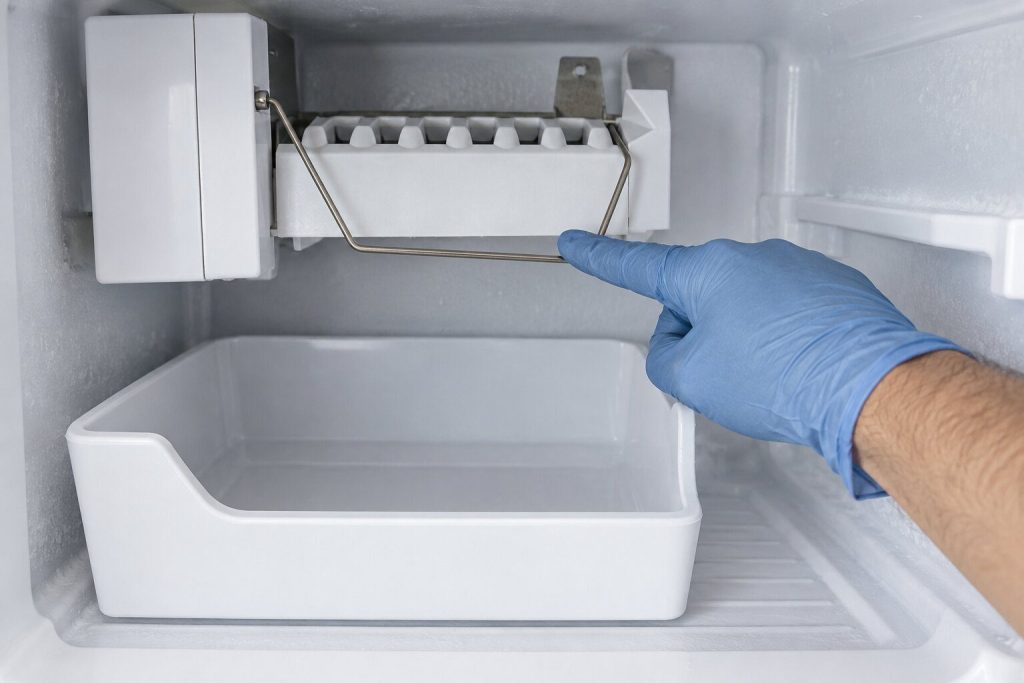
How to Tell Whether Your Frigidaire Ice Maker Is Actually Switched On
A wire arm knocked up by a box of frozen food is the cheapest reason a household goes a week without ice — and it looks exactly like a broken ice maker.
Read more
Tell us the model number and what it is doing.
This article is based on:
- Official manufacturer documentation
- Internal repair procedures
- Technician repair history
- Company quality standards