Common Problems
Calibrating a Frigidaire Oven, and When Calibration Is the Wrong Answer
Yes on most current models. The offset is entered from the control panel — usually by holding the bake pad for several seconds until the display shows a temperature or a zero, then adjusting up or down, typically within about thirty-five degrees either way. The manual for your model names the exact key sequence and it varies. But before adjusting anything, measure properly: an oven thermometer in the middle of the cavity, door shut, over a full preheat plus at least twenty minutes of settled operation. What you are looking for is the average, because the real temperature always swings either side of the setting as the element cycles — twenty-five degrees of swing is ordinary and cannot be calibrated away. Calibration fixes an oven that is consistently off by a constant amount. It does nothing for an oven that never arrives, takes forever, or is wrong by a different amount at different temperatures.
The full guide
Can I calibrate my Frigidaire oven — yes, on most models, and the more valuable half of this page is the part about when you should not.
Can I calibrate my Frigidaire oven? The swing is not an error
Start here, because it saves a good number of unnecessary adjustments.
An oven does not hold a temperature. It cycles: the element comes on until the sensor says the cavity is above the setting, goes off until it falls below, and comes on again. The real temperature inside is always moving, and on a domestic oven a swing of around twenty-five degrees either side of the mark is completely ordinary.
So a thermometer that reads 372 at one moment and 328 at another is not describing a broken oven. It is describing a working one, caught at two ends of the same cycle.
What matters for baking is the average across the cycle, and that is what a calibration offset moves.
Measure it properly first
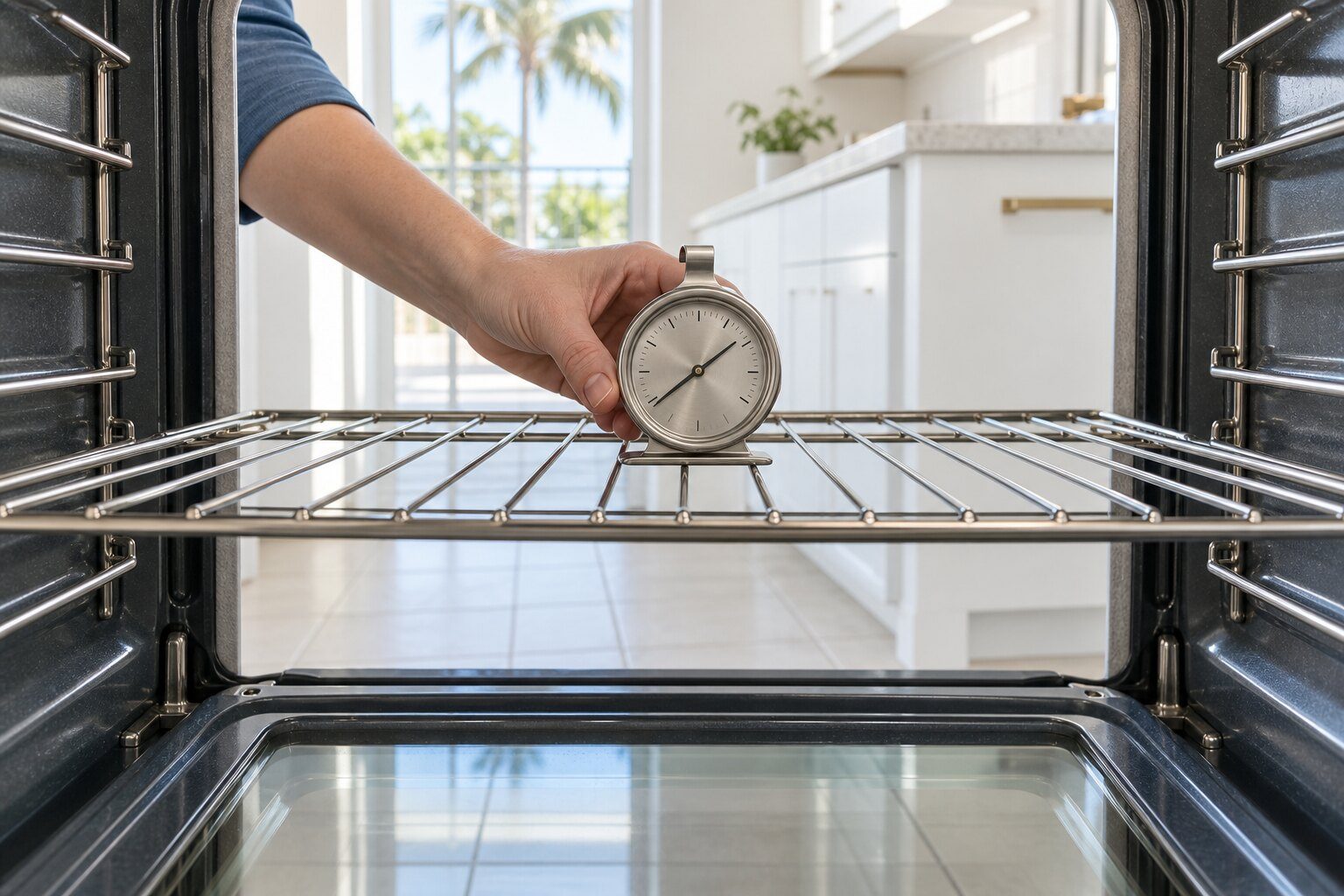
An oven thermometer on the center rack, not touching a wall or a support. Preheat to 350. Then wait twenty minutes past the beep before reading anything at all.
That waiting is the part people skip and it changes the answer. The beep means the air has arrived at temperature; the walls, the racks and the door have not, and until they have, the cavity behaves like a colder oven than the display claims. That is also why the first batch of anything bakes differently from the second.
Then read it several times over ten minutes, note the highest and the lowest, and take the midpoint. That midpoint is your oven's real temperature.
Then decide whether calibration is even the right tool
Consistently off by a constant amount — reads 325 when set to 350, and 425 when set to 450 — is exactly what calibration is for. Enter the offset and the whole range moves with it.
Wrong by different amounts at different temperatures — fine at 350, badly out at 450 — is not a calibration. That pattern points at the sensor's resistance curve drifting, and an offset will fix one end while making the other worse.
Never arrives, or takes far too long. Not a calibration either. On an electric range that usually means one of the two elements is not working, and the oven is heating on half its capacity. It will eventually get close, slowly, and no offset changes that.
Wildly out, by fifty degrees or more. Beyond what the adjustment covers and past the point where adjusting is honest. Measure the sensor.
How the adjustment is entered
The sequence varies by model and the manual for yours names it, but the shape is the same on most: hold the bake pad for several seconds until the display changes to show either a temperature or a zero, use the arrows or the number pads to move it up or down, and confirm.
The range available is typically around thirty-five degrees either way.
One habit worth keeping: write down what you set. An oven that has been adjusted twice by two different people, neither of whom recorded it, is an oven nobody can reason about — and we have arrived at kitchens where the answer was a forgotten offset from four years ago.
The codes that mean stop adjusting
This maker publishes two that are directly relevant here, and both mean the sensor circuit rather than the calibration.
F30, open probe. The control is looking for a resistance and finding nothing — the sensor, its plug at the back of the cavity, or the harness between them.
F31, shorted probe. The opposite reading on the same circuit: a resistance far lower than any real temperature would produce. A sensor cooked in a self-clean cycle fails this way.
If either of those has appeared, the oven's own measurement is unreliable and calibrating against it is calibrating against nothing. That is a meter and a part, and on this badge the sensor is stocked.
And one thing that is not the oven at all
Before adjusting anything, check the thermometer you are measuring with against a second one, or against boiling water — it should read 212 at sea level, which Miami effectively is.
Cheap dial thermometers are routinely out by more than the oven they are being used to judge, and we have been called out to calibrate an oven that turned out to be correct and a five-dollar dial that was twenty degrees low.
If it turns out to be a repair
What this leads to, and what it costs
Every job on this site is priced the same way: an on-site diagnostic first, the figure agreed in writing before anybody starts.
-
Oven temperature is wrong
Sometimes a failure, sometimes an oven behaving correctly and a recipe written for a different one. These cavities are allowed to swing either side of the setting as the thermostat cycles, and a new oven often runs truer — and hotter at the edges — than the twenty-year-old machine it replaced. A thermometer and three readings settle which of those you have.
- A cavity swings by design; the question is where the middle of the swing sits
- A drifting sensor is a part; a small consistent error is a calibration offset
- A door that leaks heat produces exactly this with nothing electrical wrong
-
Oven temperature and calibration service
Baking that has gone wrong without anything obviously failing: cakes that sink, a cavity that runs twenty degrees under, a machine that was fine until it was moved. Most of these are the sensor or the calibration, and both are cheap to establish. It is also the visit where we find out that a new oven is behaving correctly and the recipe was written for an old one.
- Cheap to measure and often not a failure at all
- A sensor reading high is the commonest single cause
- Ovens can be offset in software; not every complaint needs a part
-
Range error code F30
Frigidaire range error code F30: The oven sensor's circuit is broken — the control is looking for a resistance and finding nothing. Which machines can raise it, what the maker publishes about it, and what to do next.
What this one means -
Range error code F31
Frigidaire range error code F31: The opposite of an open probe and the same circuit: the control is reading a resistance far lower than any real temperature would give it. Which machines can raise it, what the maker publishes about it, and what to do next.
What this one means
Questions people ask about this
Can I calibrate my Frigidaire oven if it is out by eighty degrees?
The adjustment usually does not go that far, and an oven that wrong is not a calibration problem. Eighty degrees points at the sensor reading badly or at one of the two elements not working, and both are measured rather than adjusted.
My cheap oven thermometer disagrees with the display. Which is right?
Possibly neither. Dial thermometers hanging from a rack are frequently out by more than the oven is, and they read the air at one spot. Check yours against a second one, or against boiling water at 212 degrees, before trusting it enough to adjust anything.
Common Problems
More guides like this one
-
Why a Frigidaire Dishwasher Cycle Takes as Long as It Does
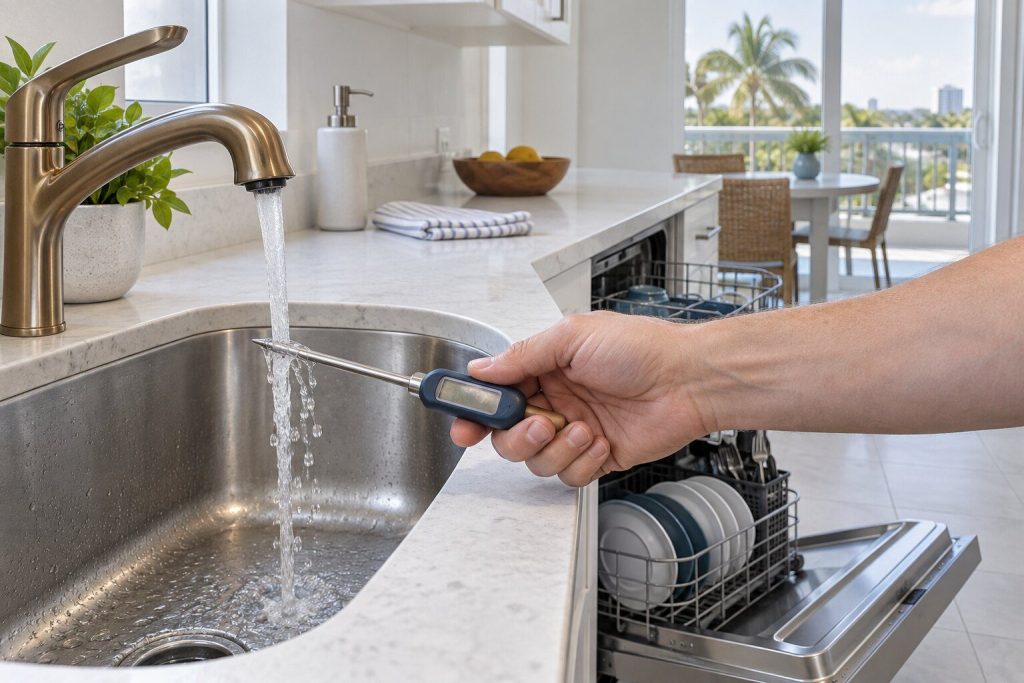
Two to three hours is normal, and the reason is heat. The machine waits for its water — about a minute or two of delay for every degree of temperature rise.
Read more -
Unlocking a Frigidaire Dishwasher That Is Ignoring Every Button
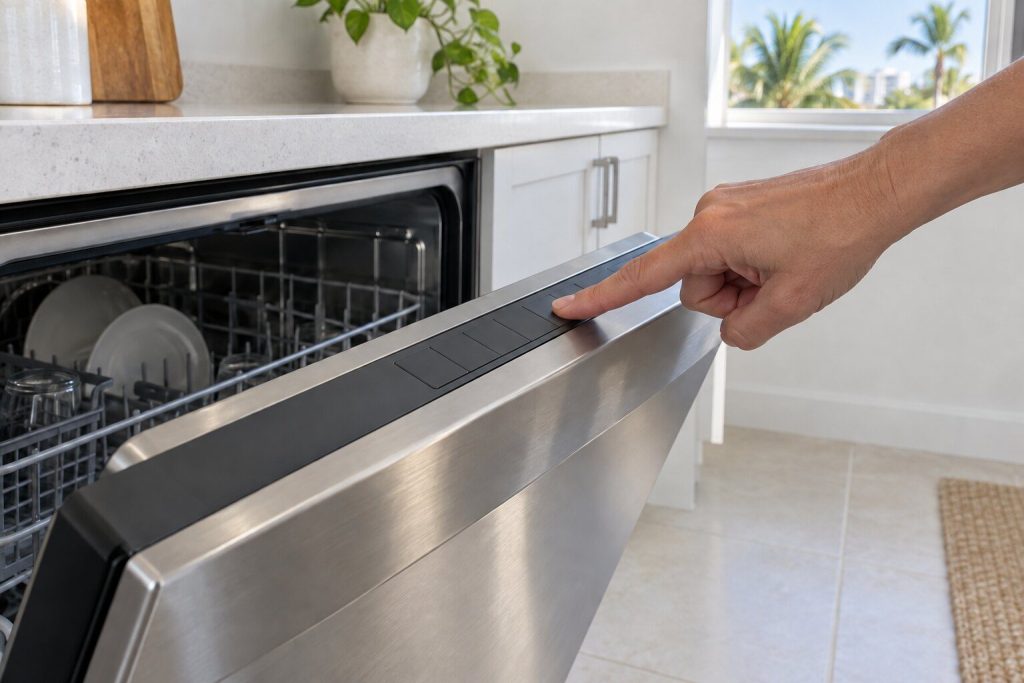
Three different things get confused here: the control lock, a delay start counting down, and a door latch switch that is not making contact.
Read more -
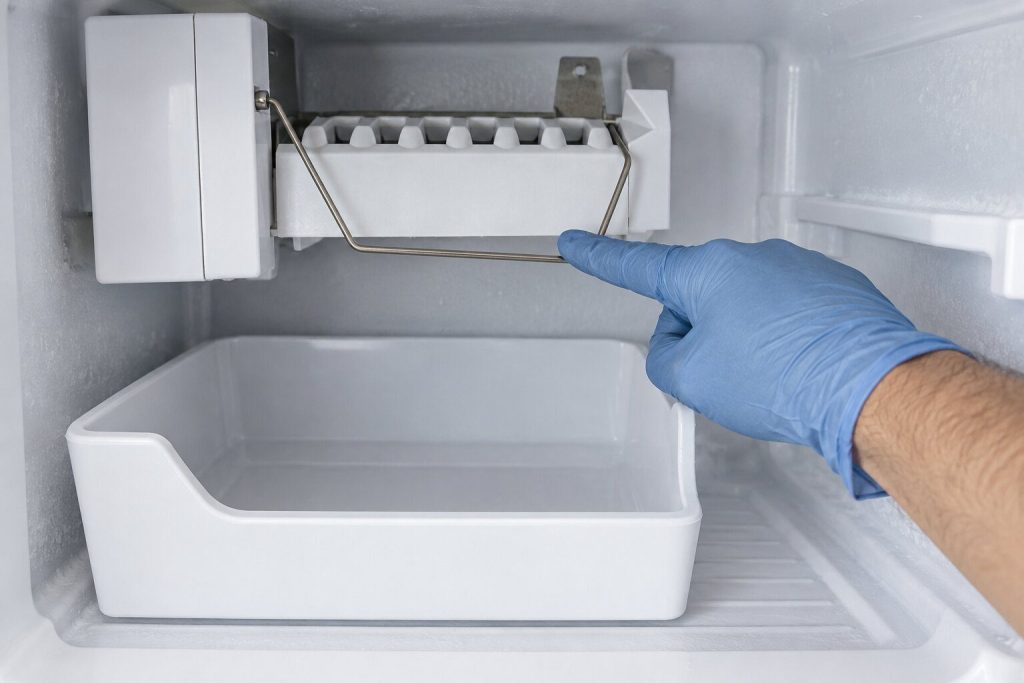
How to Tell Whether Your Frigidaire Ice Maker Is Actually Switched On
A wire arm knocked up by a box of frozen food is the cheapest reason a household goes a week without ice — and it looks exactly like a broken ice maker.
Read more
Tell us the model number and what it is doing.
This article is based on:
- Official manufacturer documentation
- Internal repair procedures
- Technician repair history
- Company quality standards