Troubleshooting
Forcing a Defrost on a Frigidaire Refrigerator, and Why It Is a Test
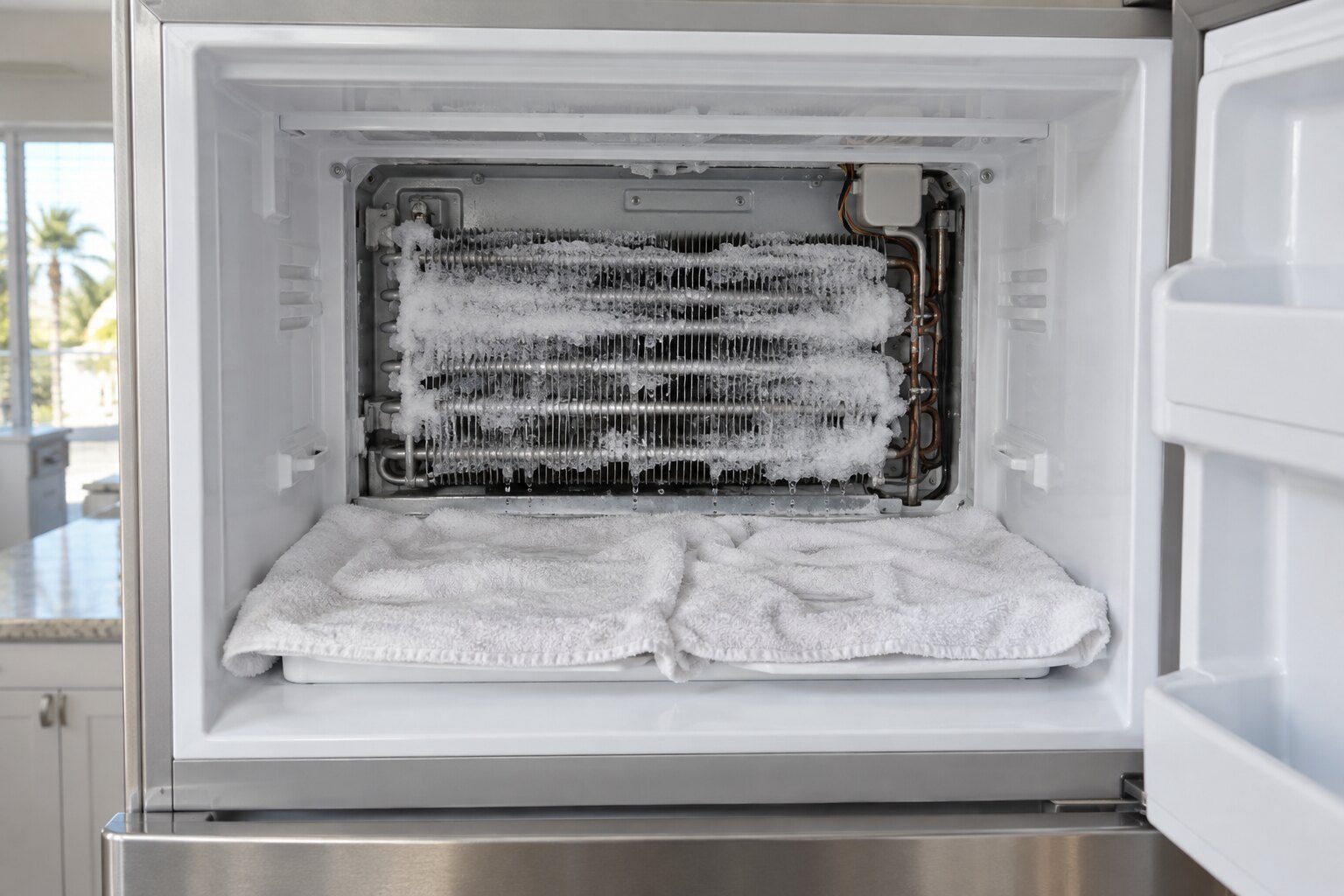
Some models have a forced-defrost sequence entered from the panel — commonly a combination held for several seconds, and the manual for your model names it, because it varies. On cabinets without one, the reliable method is the slow one: empty it, prop the doors and leave it unplugged for twenty-four hours with towels on the floor, until every trace of ice behind the rear panel has gone. Neither of those is a repair. The defrost circuit is three cheap parts — a heater, a bimetal thermostat and the control that decides when — and clearing the ice simply resets the clock on whichever of them has failed. The information is in what happens next: a cabinet that stays healthy for months had a one-off event, while one that frosts up again within two or three weeks has a dead heater or thermostat, and the interval between failures is a measurement worth giving a technician.
The full guide
How to force defrost a Frigidaire refrigerator is worth answering carefully, because the thing most people want from it — a fixed refrigerator — is not what it delivers.
How to force defrost Frigidaire refrigerator: what a defrost cycle actually is
Every frost-free cabinet is quietly fighting ice all day. The evaporator coil behind the rear wall of the freezer is the coldest surface in the machine, so every bit of moisture that gets in — from food, from the air, from a door opening — freezes onto it.
To stop that closing the coil off entirely, the machine runs a defrost cycle several times a day: a small heater beside the coil comes on for a few minutes, melts what has collected, and the meltwater runs down a trough at the back and out through a drain tube to a pan by the compressor, where it evaporates.
Three parts make that happen. The heater, the bimetal thermostat that stops it once the coil is above freezing, and the control that decides when to run it. Any one of them failing produces the same visible result: ice building up until the airflow chokes.
What "forcing" a defrost does and does not do
It melts the ice. That is all it does.
The cabinet will work again afterwards, sometimes for weeks, because a clear coil moves air again. But nothing about the circuit has been repaired, so the same part that stopped working is still not working, and the frost begins rebuilding from the moment the machine is switched back on.
This is why we would rather call it a test than a fix. Used that way it is genuinely valuable.
How to do it
If your model has a forced-defrost mode. Some do. It is usually a combination of pads held for several seconds, and the sequence varies enough between models that guessing at it is not useful — the manual for your model number names it. The mode runs the heater directly and takes twenty to thirty minutes.
If it does not. The slow way, and it is the one that always works: take the food out, prop both doors open, unplug the cabinet, put towels down, and leave it for twenty-four hours. Every last trace of ice behind the rear panel has to go, including what you cannot see, and that takes far longer than it looks like it should.
Do not attack it with a hair dryer or a heat gun. That is how people warp a liner, melt a drain tube or split the aluminum of the coil itself, converting a cheap repair into an expensive one.
The measurement, which is the point
Note the date. Then watch.
Frost returns within two or three weeks. The defrost circuit is not running at all. That is a dead heater, a failed bimetal thermostat, or a control that never calls for it — three cheap parts, all stocked on this badge, told apart with a meter in about twenty minutes.
Frost returns in a couple of months. Partial function, or an outside contribution. A door seal letting warm wet air in all day will overwhelm a working defrost circuit in this climate, and so will a door left ajar regularly.
It stays clear for months. Then what you cleared was a one-off — a long power cut, a door left open overnight, a freezer packed so hard the air could not circulate.
That interval is worth more to a technician than the frost itself, and it costs nothing but a note on the calendar.
The other thing to check while it is empty and open
The drain. On these cabinets the defrost water runs to a small trough behind the rear panel and out through a tube. That trough freezes solid on a machine whose defrost circuit is struggling, and then the meltwater has nowhere to go but forward — under the crisper drawers, and eventually onto the kitchen floor.
If your frost problem arrived alongside water under the crispers or a sheet of ice on the freezer floor, the drain is part of the story, and a defrost with the cabinet open is the one chance to see it clearly.
Why this happens more here
Two local reasons, and both are about moisture rather than about the machine.
Every door opening in a South Florida kitchen admits air that is warmer and much wetter than the same opening elsewhere. And a hardened door gasket — which is the commonest quiet failure on a cabinet over about eight years old — admits that air continuously, all day, whether anyone opens the door or not.
A defrost circuit is sized for normal moisture. Give it a leaking seal in August and it loses, and the household sees a frost problem where the actual failure is a strip of rubber.
That is worth checking before anybody replaces a heater: the dollar-bill test takes a minute, and it occasionally makes the whole repair unnecessary.
If it turns out to be a repair
What this leads to, and what it costs
Every job on this site is priced the same way: an on-site diagnostic first, the figure agreed in writing before anybody starts.
-
Ice on the back wall, or a freezer that keeps growing a crust Frost building up inside
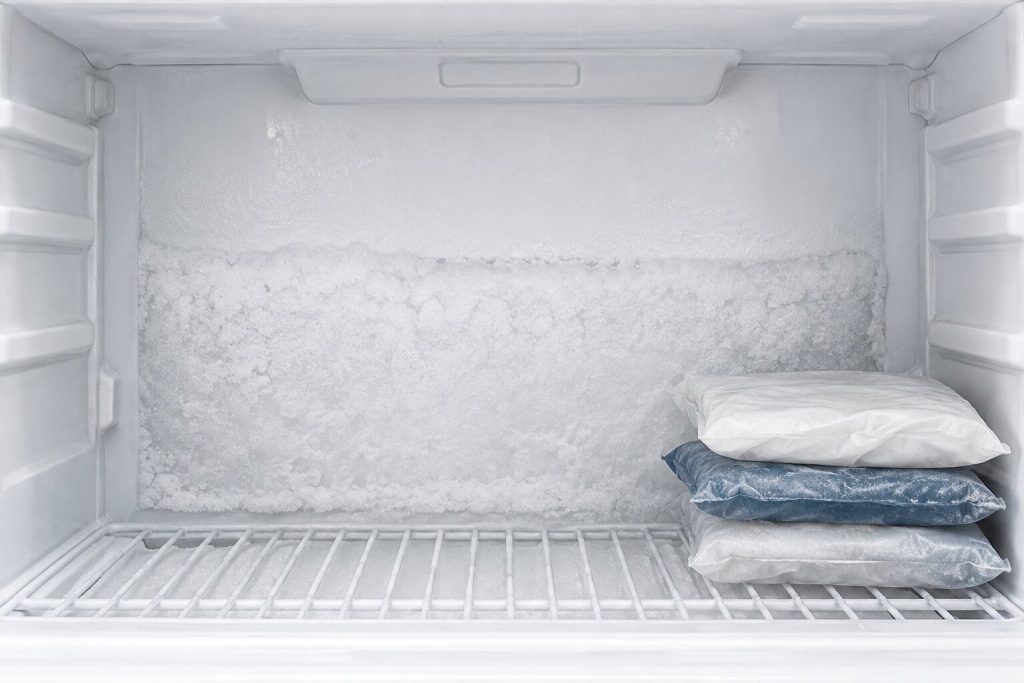
A frost-free cabinet is not supposed to accumulate anything, so frost is always a message. Where it is tells us which message: a sheet on the freezer back wall is the defrost circuit, frost around the door is a seal, and a fine crust over everything after a hot week is usually the humidity that came in through a door that was left ajar.
- A sheet of ice on the back wall is the defrost circuit, and it will not clear itself
- Frost at the door edge is a seal or an alignment question
- Chipping it out buys a week; the reason it formed decides whether it comes back
-
from $159 Defrost system repair
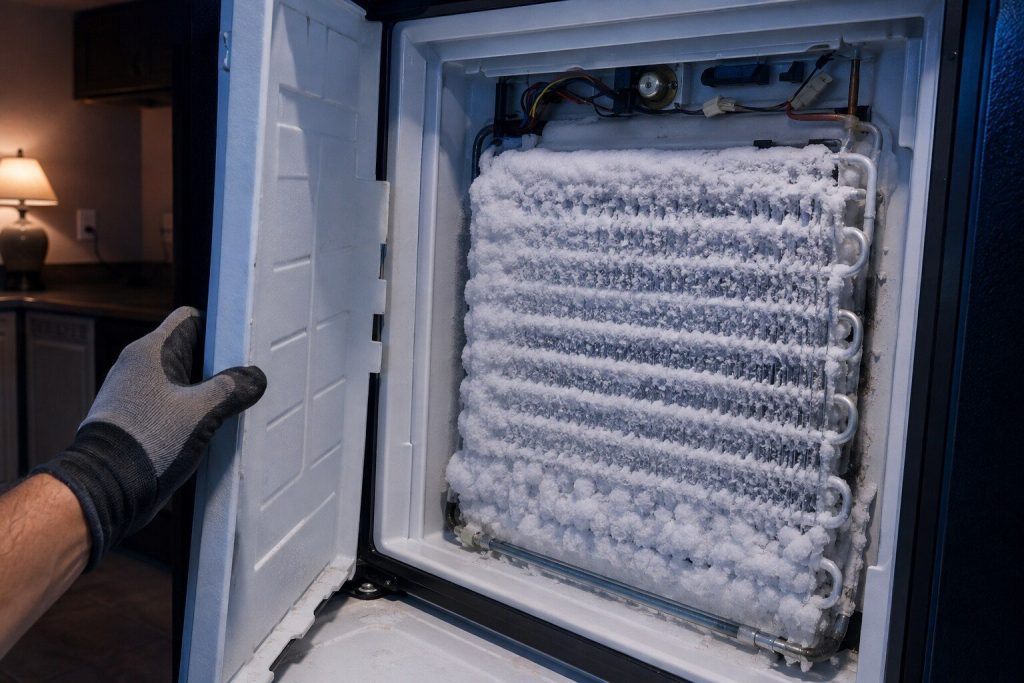
Frost where there should be none, a coil in a block of ice, or a cabinet that cools for a few days after every service call and then drifts again. Frost-free refrigeration has a heater, something that decides when to run it, and a drain to take the meltwater away — and in South Florida all three work harder than they were designed to, because every door opening lets in air that is carrying water.
- Heater, thermostat or sensor, and the control that decides between them
- This climate loads the defrost circuit harder than the design assumed
- A blocked drain is part of the same system and is checked in the same visit
-
One half of the cabinet is fine and the other is not Fridge warm, freezer cold
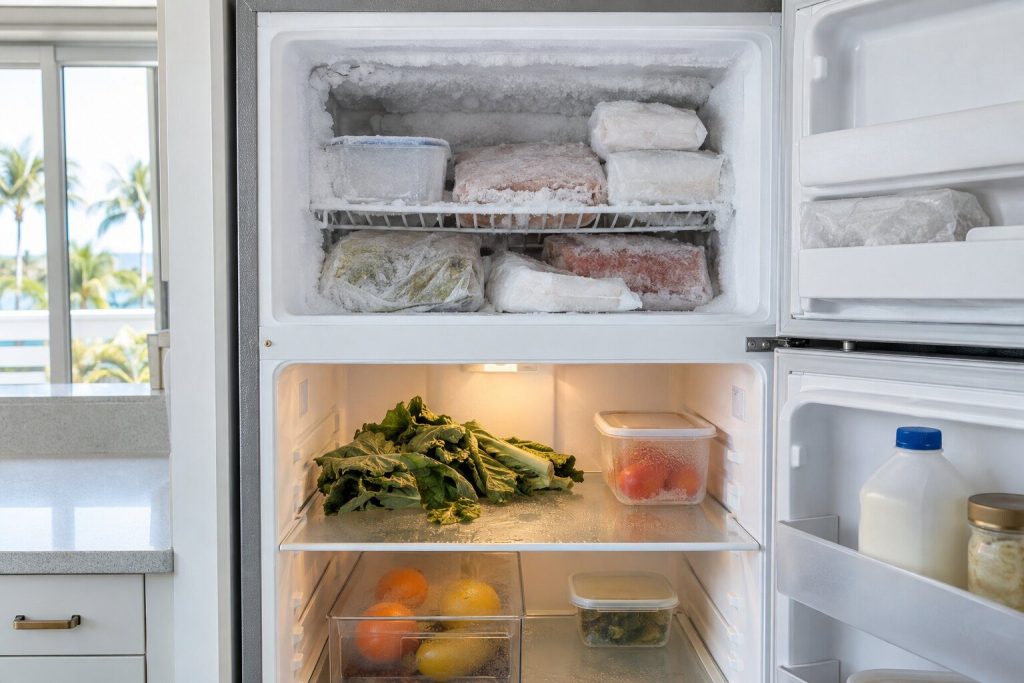
This is the single most useful thing an owner can tell us about a refrigerator, because it rules out most of the expensive answers immediately. Almost every cabinet this badge sells makes its cold in one place and moves air to the other, so a cold freezer proves the sealed system is working and points the whole diagnosis at air: a fan, a damper, a duct or a coil under ice.
- A cold freezer proves the compressor and the refrigerant are doing their job
- The problem is air: fan, damper, duct or a coil under frost
- This is usually the cheaper half of the refrigeration repair list
Questions people ask about this
How to force defrost a Frigidaire refrigerator without a panel sequence?
Empty it, prop both doors open, unplug it and give it a full twenty-four hours with towels down. A hair dryer speeds it up and is also how people melt the liner and split a drain tube — the slow way costs a day and nothing else.
How soon should it frost up again?
It should not. A cabinet with a working defrost circuit clears itself several times a day and never accumulates visible ice. Frost returning within a month means the circuit is not running, and the interval is worth telling us.
Troubleshooting
More guides like this one
-

A Frigidaire Freezer After a Power Cut: What to Reset and What to Measure
This maker publishes no code at all for any freezer, so there is nothing to read. The whole answer is a thermometer, a clock, and the door kept shut.
Read more -
Resetting a Frigidaire Dishwasher After the Power Has Been Out
In this county an afternoon outage is weather, not an emergency. Machines come back in three states, and only one of them needs anything from you.
Read more -

Hard-Resetting a Frigidaire Dryer, on a Machine That Publishes No Codes
There is no code table for any dryer this maker builds. So a reset here is not clearing a message — it is testing a thermal fuse.
Read more
Tell us the model number and what it is doing.
This article is based on:
- Official manufacturer documentation
- Internal repair procedures
- Technician repair history
- Company quality standards