Common Problems
How to Tell Whether Your Frigidaire Ice Maker Is Actually Switched On
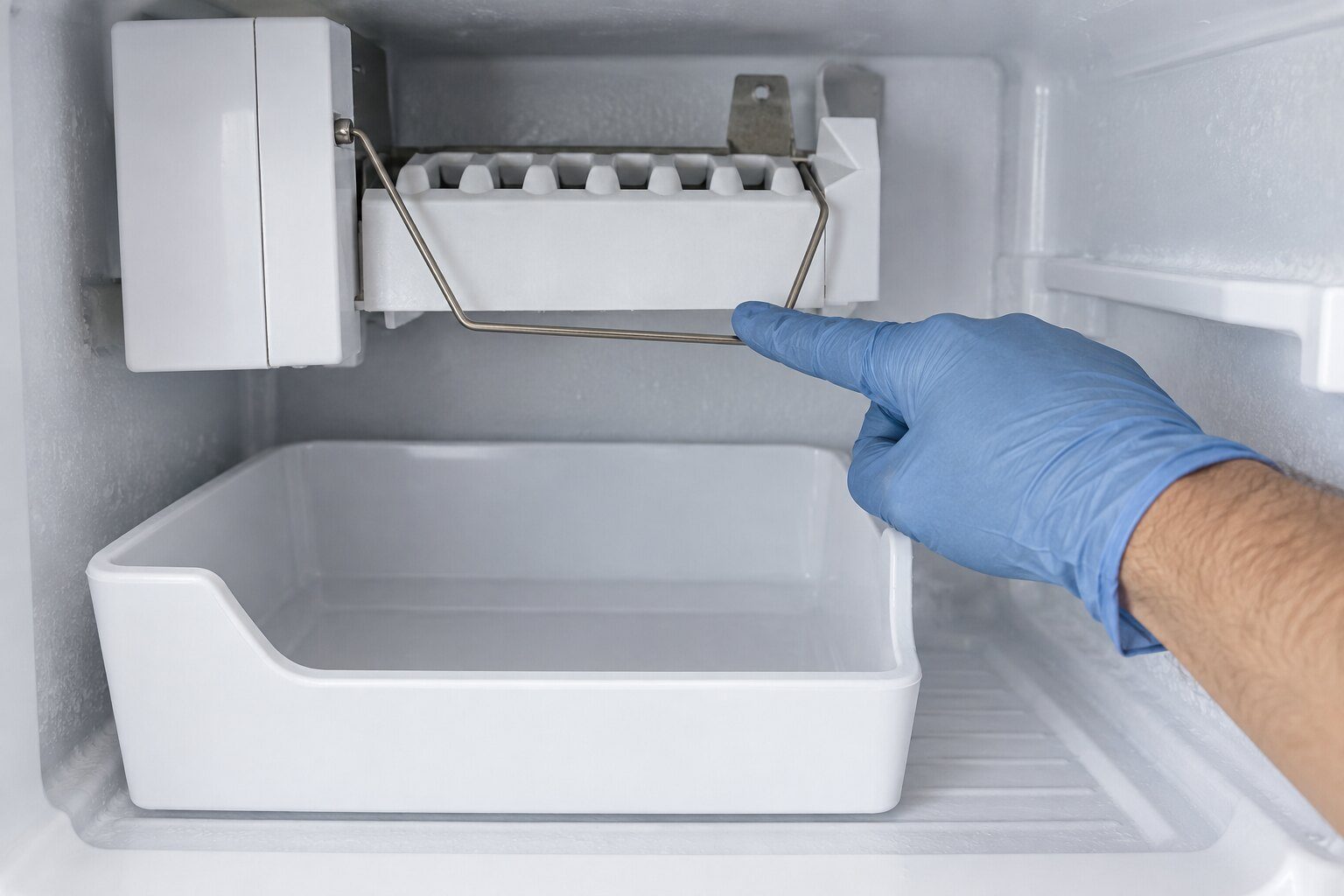
There are three switches on most of these and any one of them will stop production silently. First, the mechanical one: pull the bin and look for a wire arm on the side of the module. Down means on; horizontal or raised means the machine believes the bin is full and has stopped. Second, the electronic one: on cabinets with a display, ice making is a setting on the panel, and it can be switched off by a sleeve wiping the front. Third, on some models a slide switch or a small toggle sits on the ice maker itself. Confirm all three, then give it a full day — a maker that has just been switched back on takes twelve to twenty-four hours to fill a bin, so an empty bin two hours later proves nothing.
The full guide
How do I know if my Frigidaire ice maker is on is a question with an embarrassing answer often enough to be worth two minutes before anybody is called out.
How do I know if my Frigidaire ice maker is on? There are three switches, not one
That is the part that catches people. An ice maker can be switched off in three different places, and none of them announces itself.
The wire arm. A loop of stiff wire on the side of the module that rides up as ice fills the bin. Up means stop. It is a mechanical bin-full sensor and it works perfectly — including when it has been pushed up by something that is not ice.
The panel. On any cabinet with a display, ice making is a setting. It can be turned off deliberately, and it can be turned off by a forearm or a cloth crossing the front while somebody cleans it. It stays off through a power cut, so nothing about a storm will restore it.
The module's own switch. Some versions carry a small slide or toggle on the ice maker body itself.
All three have to be on. Any one of them off produces an identical, completely silent nothing.
The box of frozen peas
This is the most common single cause we find, and it deserves saying plainly.
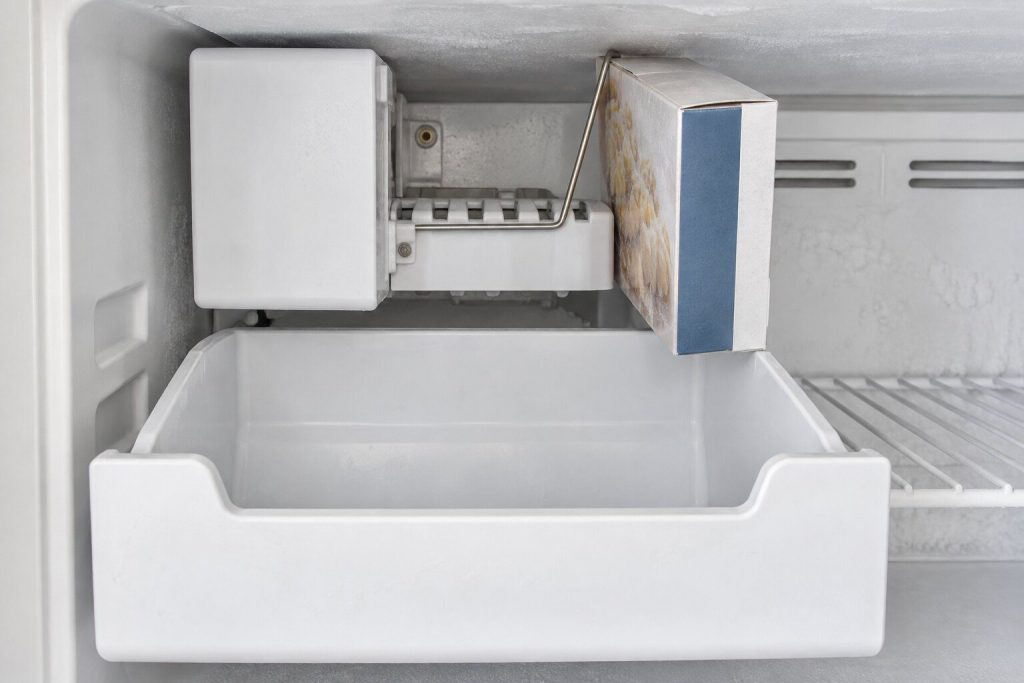
Somebody buys frozen food, opens the freezer, and puts a box in the space beside the ice bin. The box catches the wire arm on the way in and lifts it. The ice maker reads that as *bin full*, stops, and never starts again — because the box does not move, and the arm stays up.
A week later the household has no ice and concludes the ice maker has died. The repair is to move the box.
We are not being flippant about this. It is a real and frequent call, and on a badge where the diagnostic is credited toward the repair, it is still an afternoon and a fee for something that took ten seconds to undo.
The optical version
Newer cabinets often have no arm at all. Instead there are two small windows facing each other across the bin housing: one emits an infrared beam, the other looks for it. Ice in the way means full.
Which means anything else in the way also means full. Frost on a lens after a door has been left ajar. A cube that fell out of the bin and lodged against the housing. A smear from a cloth. Wipe both lenses with a dry finger and look again.
After you switch it back on, wait
A maker starting from empty runs a cycle roughly every ninety minutes to two hours. Filling a bin is most of a day.
So the test is not *is there ice in an hour*. It is: put the arm down, close the door, leave it alone until tomorrow. Checking every two hours by opening the freezer actively makes it slower, because each opening lets warm humid air onto a mold that is trying to reach nine degrees.
If all three switches are on and it still makes nothing
Then the switch was not the answer, and the next look is the cheapest possible diagnostic: pull the bin and look at the mold itself.
Dry mold. No water is arriving. That is the supply side — the shut-off at the wall, a crushed line behind the cabinet, or the fill valve.
Mold full of a solid block. Water arrived and was never released. That is the harvest side — the mold heater or the ejector motor.
Mold with a thin, hollow shell. Water arrived, but not enough of it. Supply side again, and usually the valve or the pressure rather than the module.
Those three sights split the machine in half, and they are worth having before you call anybody — including us.
If it turns out to be a repair
What this leads to, and what it costs
Every job on this site is priced the same way: an on-site diagnostic first, the figure agreed in writing before anybody starts.
-
The bin is empty and nothing is arriving Ice maker not making ice
One question sorts most of these before anybody is booked: does the water dispenser still work? Water at the dispenser but no ice separates the ice half of the circuit from the supply in a sentence, and neither water nor ice sends the whole diagnosis back to the filter and the shut-off. Half of these calls end on the water side rather than at the ice maker itself.
- Water at the dispenser but no ice narrows this to the ice half of the circuit
- No water either sends us to the filter, the line and the shut-off
- The fill tube freezing closed is commoner than the module failing
-
from $139 Ice maker repair
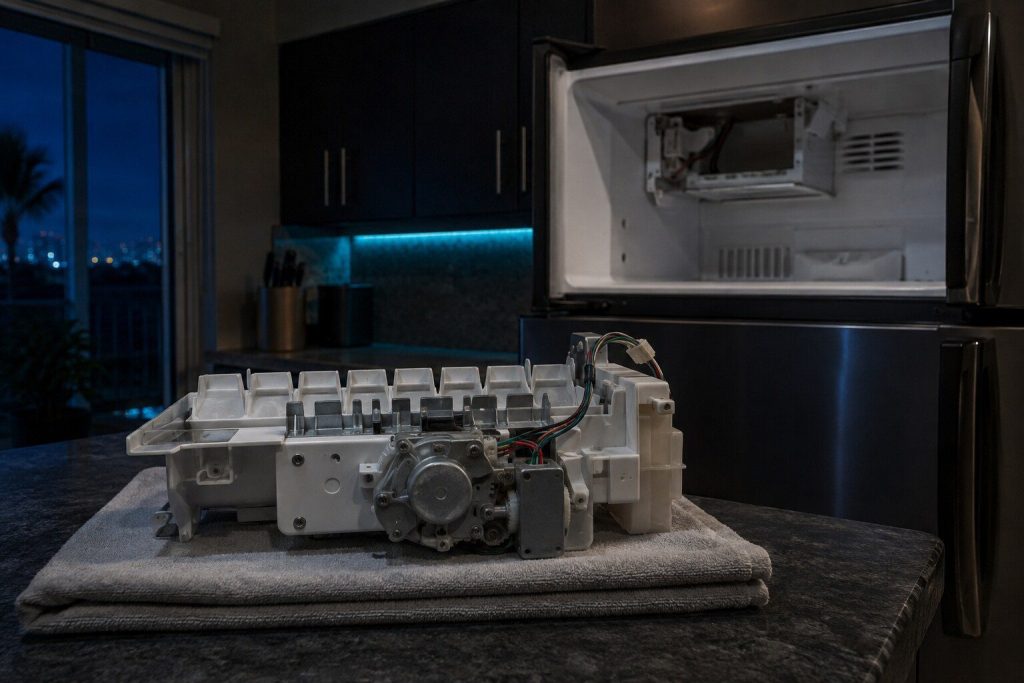
The module inside the refrigerator: no ice, hollow cubes, a bin frozen into one block, or a dispenser that grinds and delivers nothing. Half of these calls end on the water side rather than in the ice maker itself, which is why the first questions are about the filter and the dispenser rather than about the module.
- Half of these end at the filter, the valve or the fill tube
- Hollow or small cubes are a flow story, not a freezing one
- A bin frozen solid points at compartment temperature or a door seal

Questions people ask about this
How do I know if my Frigidaire ice maker is on if there is no arm?
It is an optical model. Look for two small windows facing each other across the bin housing — one sends a beam, the other receives it. Frost, a stray cube or a wiped-on smear blocks it, and the maker stops exactly as if the bin were full.
The arm is down and it still makes nothing. What now?
Then the switch is not the problem and the next question is whether water is arriving. Pull the bin and look at the mold: dry means the supply side, a solid block means the harvest side. That single look decides which half of the machine we are talking about.
Common Problems
More guides like this one
-

Why a Frigidaire Dishwasher Cycle Takes as Long as It Does
Two to three hours is normal, and the reason is heat. The machine waits for its water — about a minute or two of delay for every degree of temperature rise.
Read more -

Unlocking a Frigidaire Dishwasher That Is Ignoring Every Button
Three different things get confused here: the control lock, a delay start counting down, and a door latch switch that is not making contact.
Read more -

Registering a Frigidaire You Did Not Buy, and Why the First Thirty Days Matter
Registration does not create a warranty and not registering does not void one. What matters more is who installed it, and how long ago.
Read more
Tell us the model number and what it is doing.
This article is based on:
- Official manufacturer documentation
- Internal repair procedures
- Technician repair history
- Company quality standards