Common Problems
How a Frigidaire Ice Maker Works, and Where the Chain Breaks
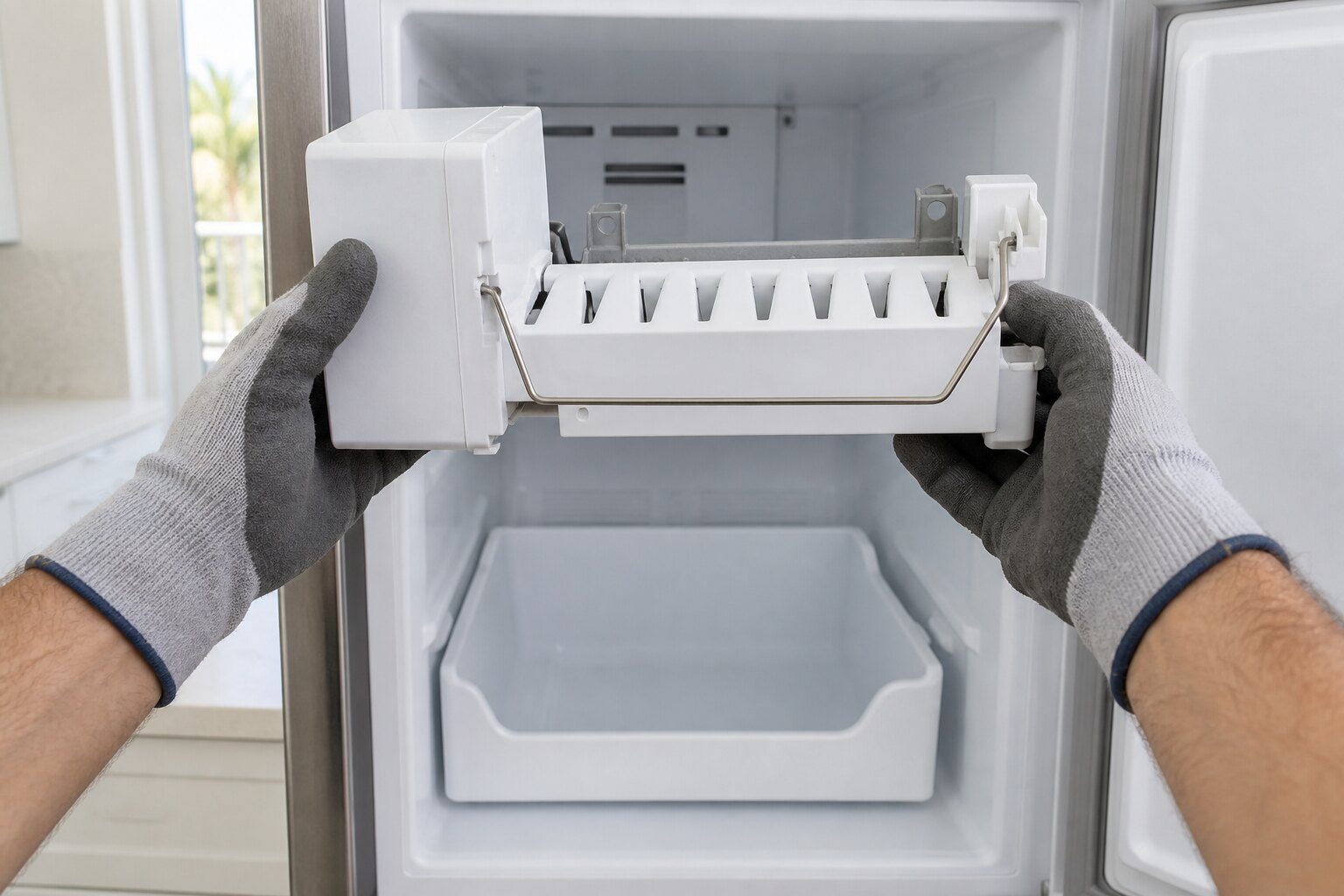
The module in the freezer is a small machine bolted inside a large one, and it repeats five steps. A valve at the back of the cabinet opens for a measured few seconds and fills the mold with water. The mold sits in the freezer until a thermostat on it reads roughly nine degrees, which is the signal the ice has hardened. A small heater under the mold warms it just enough to release the cubes. A motor turns the ejector arm and sweeps them into the bin. Then a shut-off arm or an optical sensor checks whether the bin is full, and if it is not, the cycle starts again. Every one of those five has to work, and none of them announces itself when it does not — so a household simply stops getting ice, with nothing on any display. Which link has broken is told apart by what is in the bin: nothing at all, hollow or half-size cubes, or one solid slab.
The full guide
How does a Frigidaire ice maker work is worth knowing for one reason: this is the only appliance in the kitchen that fails completely and silently, with no message of any kind.
How does a Frigidaire ice maker work? Five steps, and all five every time
Fill. A valve at the back of the cabinet opens for a measured number of seconds. It is not measuring volume — it is measuring time, which is why water pressure matters as much as the valve does.
Freeze. The mold sits in the freezer until a small thermostat clipped to it reads around nine degrees. That is the machine's proof that the cubes are hard rather than merely cold.
Harvest. A heater underneath warms the mold for a moment. Just enough to let go, not enough to melt anything.
Eject. A motor turns the plastic arm and sweeps the cubes into the bin below.
Decide. A wire arm rides up on the ice, or an optical beam is broken by it. Bin full, stop. Bin not full, go again.
That is the whole machine. It repeats those five perhaps eight to twelve times a day when it is working, and it produces nothing at all when any one of them stops.
Why there is no message
The maker documents error codes for its washers, dishwashers, ranges and refrigerators. For ice makers — the module inside the cabinet and the countertop machines both — it publishes none.
So there is nothing to look up, and this is not an omission on our part. It means a household finds out about the failure the way everybody does: by reaching for ice on a Friday and finding an empty bin.
Which also means the diagnosis is entirely about *what is in the bin*, and that turns out to be enough.
What the bin tells you
Nothing at all. Three possibilities, in order of how cheap they are. The shut-off arm is up — knocked there by a bag of frozen peas, and the machine believes the bin is full. Or no water is arriving. Or the freezer is not cold enough for the mold thermostat to ever trigger.
Hollow shells or half-size cubes. The freezing half is working. The mold simply got less water than it asked for during those measured seconds, so the cause is the valve, the line or the pressure.
One solid slab. The cubes were made and not released, or were released and then melted and refroze into each other. That points at the harvest half — the mold heater or the ejector — or at a bin nobody has emptied for a month.
Cubes that taste of the freezer. Nothing is broken. Ice absorbs whatever is around it, and old ice in a bin nobody empties will taste of last month's dinner.
The check that costs nothing and solves the most
Pull the bin out and look at the arm.
If there is a wire arm and it is in the raised position, push it down. That is it — that is the entire repair in a surprising share of the calls we take on this, and the reason it happens is mundane: somebody put a box in the freezer, it pushed the arm up, and the ice maker did what it was designed to do.
On the optical version, look for frost on the two small lenses on either side of the bin housing and wipe them.
The one that is genuinely the freezer's doing
If the freezer is running warmer than about five degrees, the mold thermostat may never reach its trigger point. The maker is not broken — it is waiting, correctly, for ice that has not hardened.
That is worth checking with a thermometer before anybody opens the module, because it means the real problem is the cabinet, and fixing the cabinet fixes the ice maker for free. In this territory the usual reason a freezer sits warm is a loaded condenser coil or a door seal that stopped closing, and neither of them puts anything on a display either.
What we do about it
The order on a visit is the same as the order above, because it goes from free to expensive: the arm, then the temperature, then whether water is arriving, then the valve, then the module itself.
The part most often replaced on this badge is the fill valve rather than the ice maker. The part most often *blamed* is the ice maker. Those two facts are the reason this page exists.
If it turns out to be a repair
What this leads to, and what it costs
Every job on this site is priced the same way: an on-site diagnostic first, the figure agreed in writing before anybody starts.
-
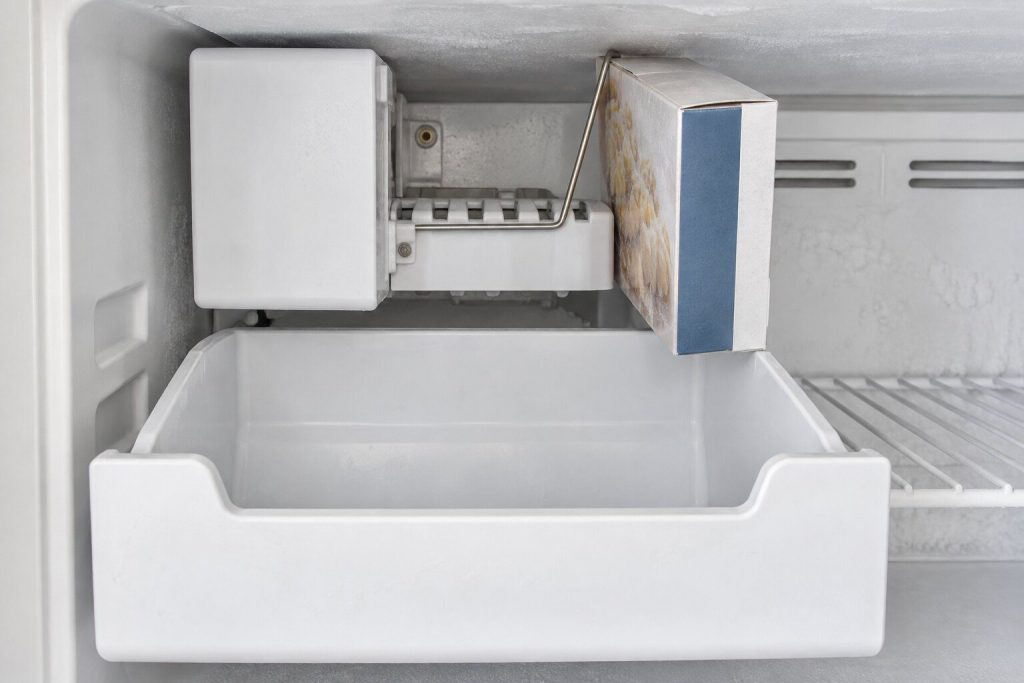
The bin is empty and nothing is arriving Ice maker not making ice
One question sorts most of these before anybody is booked: does the water dispenser still work? Water at the dispenser but no ice separates the ice half of the circuit from the supply in a sentence, and neither water nor ice sends the whole diagnosis back to the filter and the shut-off. Half of these calls end on the water side rather than at the ice maker itself.
- Water at the dispenser but no ice narrows this to the ice half of the circuit
- No water either sends us to the filter, the line and the shut-off
- The fill tube freezing closed is commoner than the module failing
-
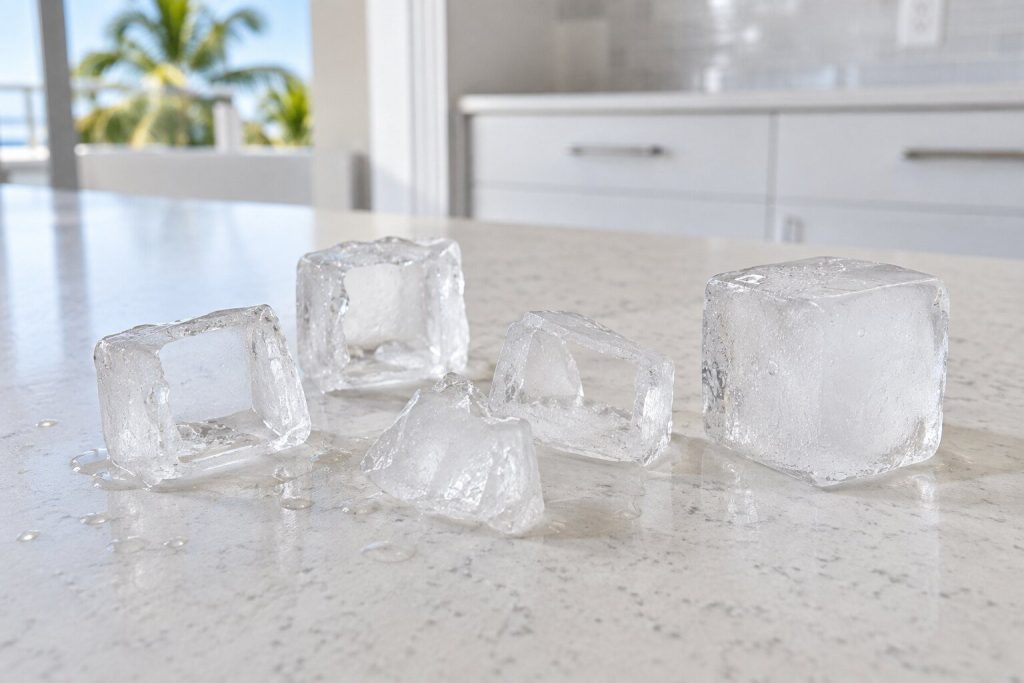
The cubes are arriving but they are not right Small, hollow or cloudy ice
This is a flow complaint rather than a freezing one, and it is almost always upstream of the ice maker. The mold fills for a fixed time, so if less water arrives in that time you get a smaller cube, a hollow one, or a shell that collapses in the glass. The filter is the first suspect, the supply is the second, and the third is a freezer that is not quite cold enough.
- The mold fills for a fixed time — less water in means a smaller cube out
- A filter past its date changes cube size before it changes anything else
- Cloudy ice is usually air and minerals in the water, not a failure at all
-

from $119 Ice maker water line and fill valve service
The supply half of the ice circuit, and the half that fails most: the shut-off at the wall, the line behind the cabinet, the filter and the inlet valve with its two solenoids. It is also the half that causes water damage, so a line that is old, kinked or made of the wrong material gets said out loud whether or not it is today's problem.
- The shut-off, the line, the filter and the valve — in that order
- A weeping valve behind a cabinet is a slow leak nobody sees for months
- Old plastic supply lines get flagged whether or not they are today's problem
-
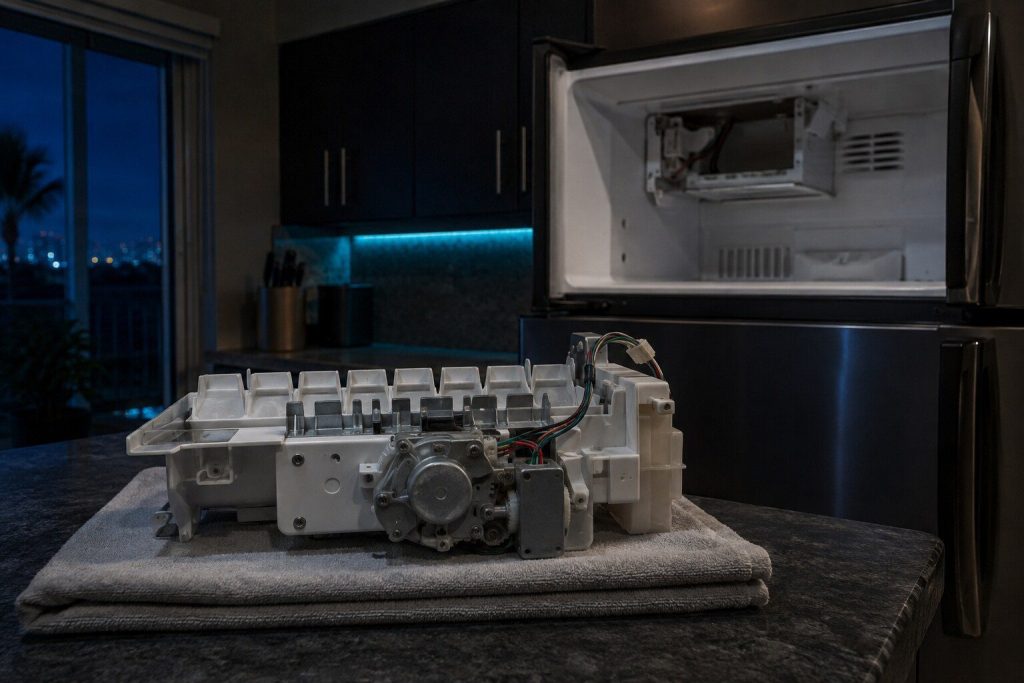
from $139 Ice maker repair
The module inside the refrigerator: no ice, hollow cubes, a bin frozen into one block, or a dispenser that grinds and delivers nothing. Half of these calls end on the water side rather than in the ice maker itself, which is why the first questions are about the filter and the dispenser rather than about the module.
- Half of these end at the filter, the valve or the fill tube
- Hollow or small cubes are a flow story, not a freezing one
- A bin frozen solid points at compartment temperature or a door seal
Questions people ask about this
How does a Frigidaire ice maker know when the bin is full?
Either a wire arm that is lifted by the ice itself, or an optical pair that shines a beam across the bin. Both are easily fooled — an arm knocked up by a box of frozen food, or a beam blocked by frost on the lens — and both stop the maker silently.
Why does it make hollow or half-size cubes?
The mold got less water than it asked for, so the problem is on the supply side: the fill valve, a partly frozen line, or low pressure at the tap. The freezing half of the machine is working perfectly — it is freezing what arrived.
Common Problems
More guides like this one
-
Why a Frigidaire Dishwasher Cycle Takes as Long as It Does
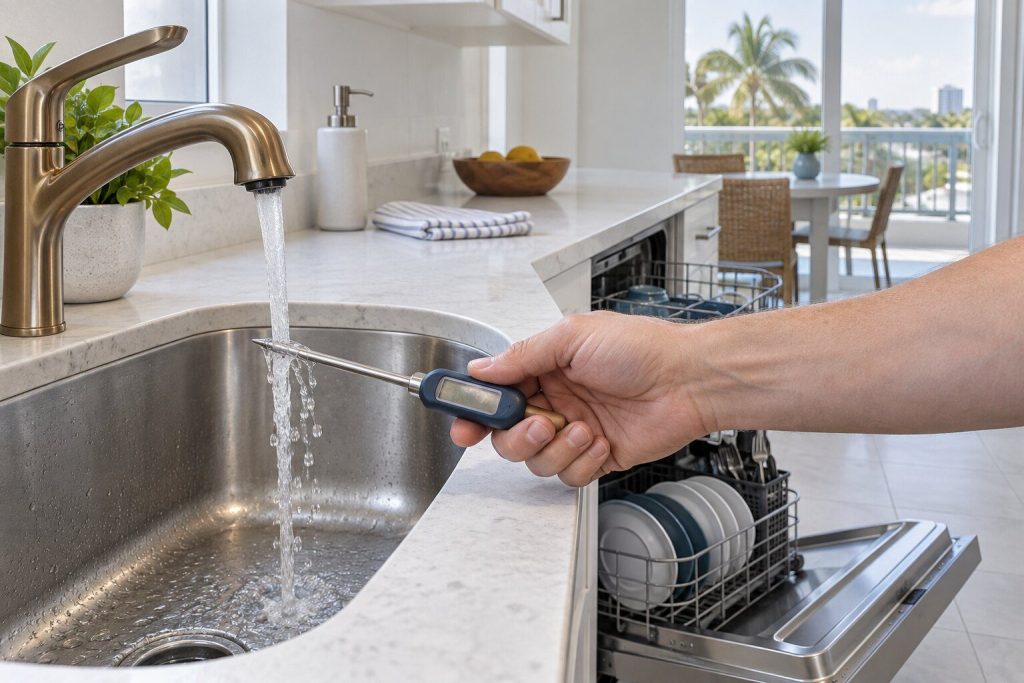
Two to three hours is normal, and the reason is heat. The machine waits for its water — about a minute or two of delay for every degree of temperature rise.
Read more -
Unlocking a Frigidaire Dishwasher That Is Ignoring Every Button
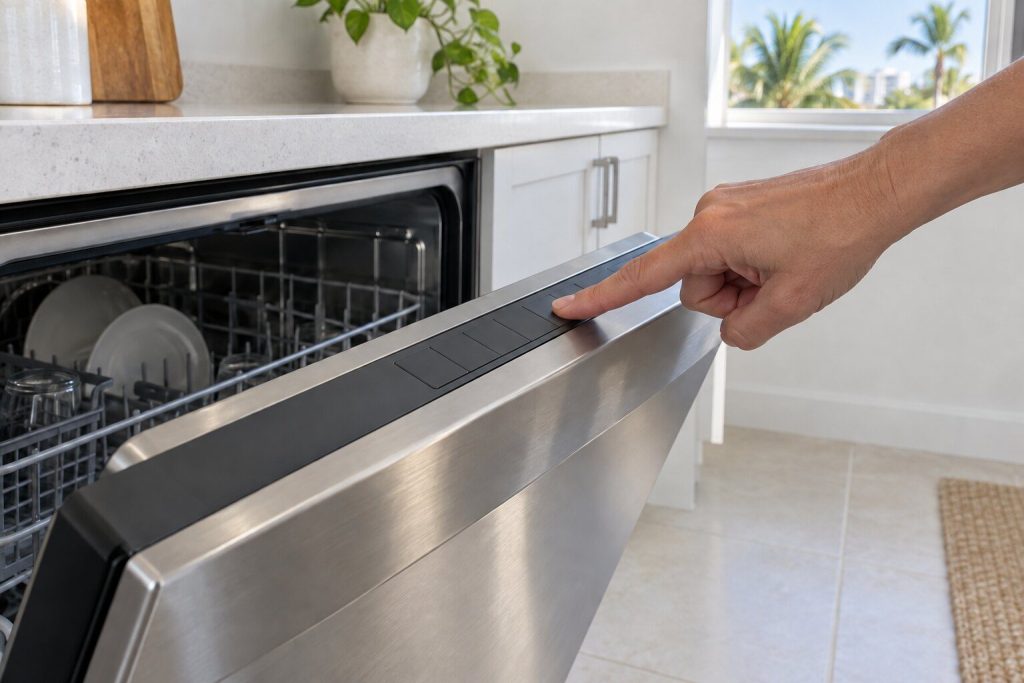
Three different things get confused here: the control lock, a delay start counting down, and a door latch switch that is not making contact.
Read more -
How to Tell Whether Your Frigidaire Ice Maker Is Actually Switched On
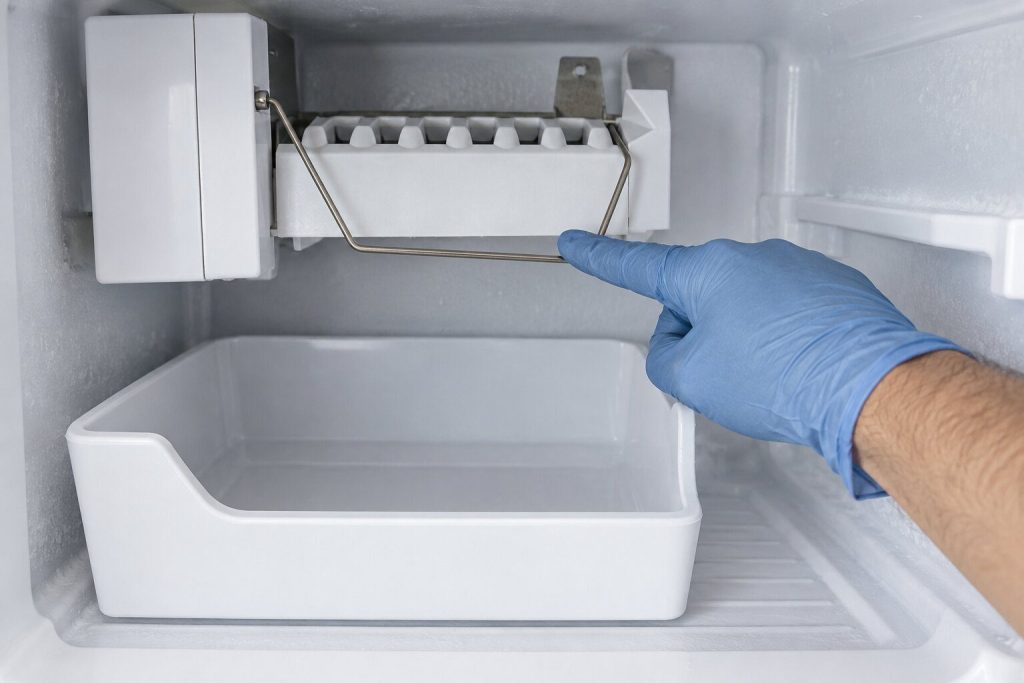
A wire arm knocked up by a box of frozen food is the cheapest reason a household goes a week without ice — and it looks exactly like a broken ice maker.
Read more
Tell us the model number and what it is doing.
This article is based on:
- Official manufacturer documentation
- Internal repair procedures
- Technician repair history
- Company quality standards